Stability and change
Stability and Change
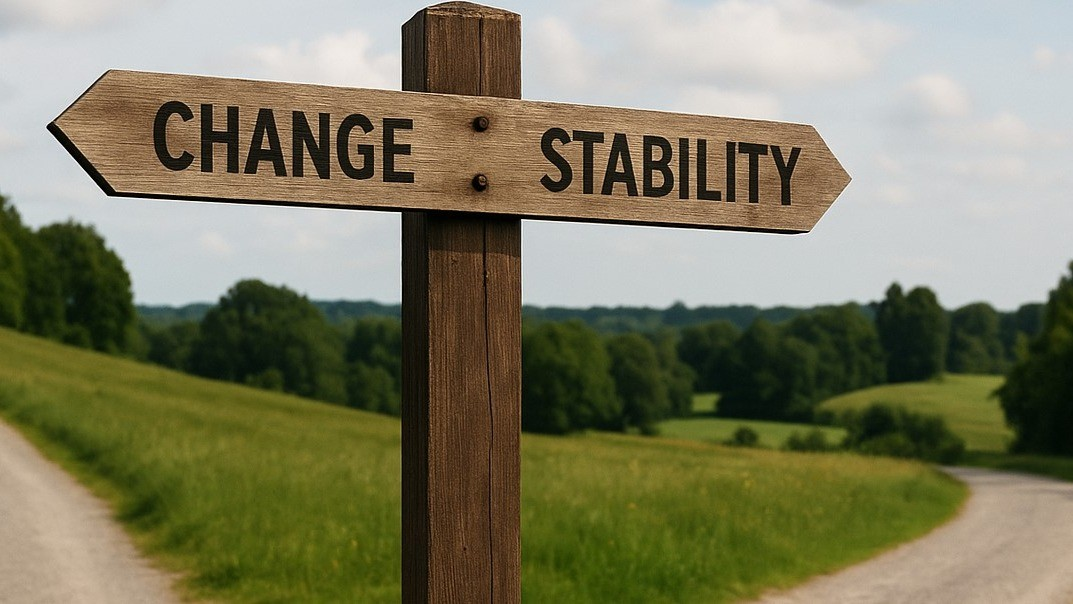
Earth’s living systems have stability, and they interact with the rest of the physical world, which is constantly changing. Systems live in changing environments. Temperature and food availability change regularly. Systems are constantly changing. Systems have to balance stability and change.
Stability is the system’s ability to maintain an internal state, or an internal structure, in the face of external changes.
Change is the system’s ability to maintain internal stability while having external changes.
This lesson is about how the system maintains stability, the system’s response to internal changes, and the changes to the system driven by the system’s external environment over a long period of time.
Homeostasis: Maintaining Stability
Homeostasis is the process of internal stability employed by living systems. Homeostasis regulates system variables, such as body temperature, the pH of blood, the concentration of glucose in the blood, and the system’s osmotic equilibrium.
System of Homeostasis
Negative Feedback
Feedback is the most popular and widely used mechanism. It maintains homeostasis by counteracting any changes from the normal, or set point, state.
Example: The regulation of blood glucose. The blood glucose levels rise after you eat. The pancreas releases insulin. Your cells absorb glucose, which lowers blood sugar levels, and then, when normal levels are restored, insulin secretion stops.
Other examples of negative feedback include:
- The regulation of body temperature by sweating and shivering
- Blood pressure regulation by the heart and blood vessels
Positive Feedback
Positive feedback is the opposite of negative feedback. It occurs when there is an amplification of change, instead of a reduction. It is less common and usually occurs in processes that require a rapid and decisive change.
Example: Blood clotting. In an injury, platelets release certain chemicals, and more platelets are attracted, which accelerates the formation of the clot. Once the clot is formed, the entire process stops.
Other examples include:
- The childbirth contractions that are triggered by oxytocin
- Lactation in mammals
Change in Populations: Evolution
While homeostasis maintains stability in individuals, in populations, change occurs over generations. It is driven by evolution, which is the process by which populations adapt to their environment over time.
Genetic Variation
Without genetic variation in populations, there wouldn’t be evolution. Variation occurs from:
- Mutations - Changes that occur randomly in DNA.
- Meiosis - Genetic recombination that occurs from sexual reproduction.
- Gene Flow - Movement of genes from one population to another.
Gene variations affect how individuals in a population will survive in a certain environment, which theory of evolution is based upon called natural selection.
Natural Selection
Natural selection is a process that takes place when individuals with preferred traits are able to live longer because of those traits.
Natural Selection Steps
- There is variation in a population.
- Not all variations will present a survival advantage.
- Those with a survival advantage will more likely live longer and reproduce.
- Over many generations, the trait will be present in a majority of the population.
Example: In England’s peppered moths population, natural selection in response to environmental changes occurred. England experienced an industrial revolution, which led to pollution and a change in the color of the trees. It originally had a lot of light colored moths that blended into the light colored trees and therefore were not predated upon. When the tree color changed to a darker color, there was a moth that had a mutation to be dark colored, and that mutation survived longer and was able to reproduce in larger numbers than the remaining light moths, leading to a change in the population of colored moths from naturally selected light colored moths to a population of dark colored moths.
Adaptation: Response to Environmental Change
An adaptation is a trait in an organism that makes it more likely to survive and reproduce in a given environment.
Adaptations can be:
Features that are physical to the organism’s body.
Example: A camel’s fat hump can store energy and water.
Processes that are internal.
Example: Humans have sweat glands to cool the body.
Actions of an organism that will improve its chance of survival.
Example: Birds flying south for the winter.
For a long time, the species has slowly evolved coping mechanisms for pressures from the environment, through the process of natural selection. These are called adaptations.
Population Dynamics: Stability and Change in Ecosystems
Ecosystems also experience stability and change. Population dynamics help us understand the change in numbers, the interactions between organisms in a population, and the effects of those interactions.
Carrying Capacity (K)
Population exceeds carrying capacity, resources become limited, population shrinks.
Abundant resources, population grows.
Population Influencing Factors:
- Biotic: Food availability, predation, disease.
- Abiotic: Temperature, water, light, soil.
Population Growth Models
J-shaped growth curve. Rapid growth occurs in ideal conditions.
Growth levels off as carrying capacity is approached. S-shaped curve.
Succession: Changes in an area over an extended period of time
Starts in areas that are void of life. E.g., areas of bare rock.
Affected areas with soil.
Both processes will eventually lead to the stabilization of the ecosystem by reaching a climax community.
Biodiversity and Change
Biodiversity is defined as the different types of organisms in an ecosystem, and at the genetic and species levels. Stability is supported by biodiversity in the following ways:
- A greater number of different species for fulfilling roles in the ecosystem.
- A greater number of species enables the ecosystem to recover from disturbances.
Change in biodiversity has either a natural reason from the environment, or an anthropogenic reason from human activity.
- Natural alterations: volcanoes, floods, outbreaks of diseases, etc.
- Changes caused by humans: habitat destruction, pollution, the climate crisis, and invasive species.
Some ecosystems, like tropical rainforests, are quicker to recover from disturbances than others, like deserts, which take longer to recover.
Fossil Record
Fossils are evidence of gradual changes in a species that support evolution. The fossils bridge the gaps in the timeline and show how modern species descend from their ancestors.
Example: Archaeopteryx is a species that perfectly combines the features of a dinosaur and a bird and is a great example of evolution.
Comparative Anatomy
Structures that are similar in several species indicate a common ancestor.
Common origin but different roles.
Example: the human arm and the whale flipper
Different origins, but act the same.
Example: a bird’s and an insect’s wings
Molecular Evidence
The closer the organisms, the more similar the DNA and protein sequences they have. The conserved genes are evidence for stability, while the changes and mutations that are present are evidence for change.
Human Influence on Stability and Change
The impact humans have on nature’s balance of stability and change is profound.
With deforestation, pollution, and industrial civilization, changes affect temperatures, rainfalls, and sea levels. This forces organisms to adapt or migrate.
With fewer forests, habitats become endangered, and organisms lose their primary habitats, threatening species survival.
Chemical and toxic waste disrupts ecosystems and organisms that try to maintain homeostasis.
Humans impact and change species’ traits without going through natural selection processes.
In a growing environment, humans can either facilitate the ecosystem’s long-term stability (through conservation) or alter and accelerate the ecosystem’s change and promote extinction.
Summary
In the study of biology, some of the main themes of study are stability and change.
- In stability, the study delves into the mechanisms of homeostasis and the role of feedback systems and cycles to regain states of equilibrium.
- On the other end of the spectrum, the study of biology looks into systems at different scales, be it genetic, population, or ecosystem, and the role of mutation and the processes of natural selection, and the processes of adaptation and succession.
- In the study of evolution, the primary focus has been on how change occurs in different populations of organisms over long periods of time and how this process results in the formation of new species, i.e., new levels of diversity (biodiversity).
- Human activities can unnaturally alter and accelerate systems, giving a population of organisms a new home to live. Biologists have been studying these processes in the hope of preserving life (biodiversity) and assisting life in adapting to a world that is in a continuous state of change.
This process has provided a fundamental understanding that is necessary to aid a population of organisms in a new home to live, while also avoiding the collapse of ecosystems.