Inheritance
Inheritance
Have you ever thought about the reason you share your eye color with your parents? Or that some traits appear for a generation and then don’t? Inheritance is the process that covers the passing down of genetic information from generation to generation. It is responsible for the reason offspring resemble their parents, and the reason that there is a genetic variation within a population.
What Is a Gene?
A gene is a section of DNA that is responsible for coding either a specific protein or trait of an organism. Genes are organized in structures called chromosomes, which, in turn, are contained in the nucleus of the organism’s cells. Organisms inherit genes from their parents. Humans, for example, have a total of 46 chromosomes, which is equivalent to 23 pairs.
Every gene also possesses alternative alleles, referred to as dominant and recessive.
Example:
- The gene that is responsible for the eye color trait contains a brown allele (B) and a blue allele (b).
- People with the Bb genotype have the dominant trait of brown eyes.
Genotype and Phenotype
Genotype
Refers to the genetic makeup of the organism (which alleles the organism has).
Phenotype
Refers to the traits that are visible as a result of the organism’s genotype.
Example: Genotype: Bb (which are brown eyes) Phenotype: brown eyes
A trait can be monogenic, meaning that a single gene controls the trait, or polygenic, meaning that multiple genes control it.
Mendelian Genetics
Gregor Mendel, studying pea plants, formulated the basic principles of the law of inheritance.
Law of Segregation
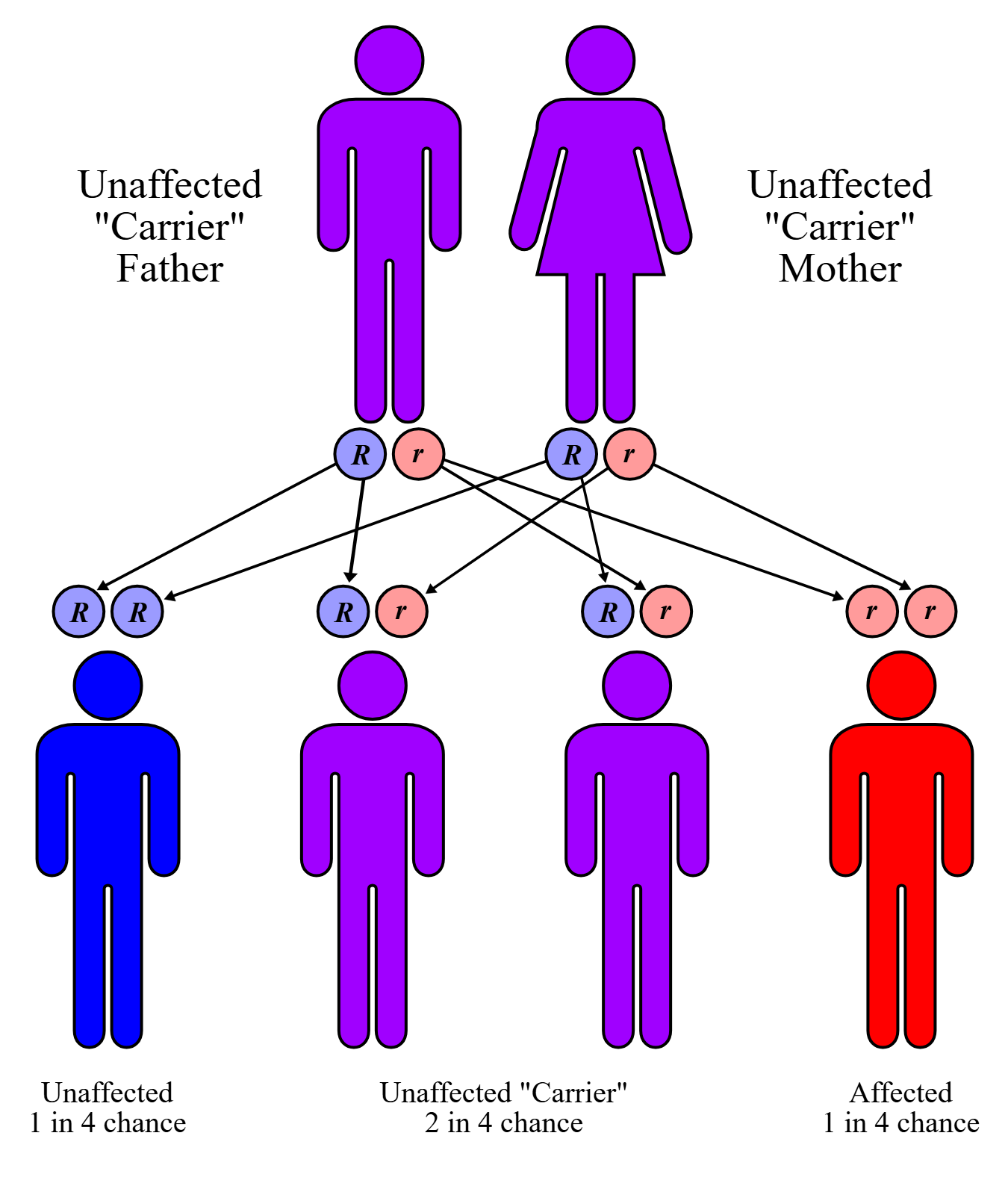
An organism has two alleles for each gene and as gametes are formed, the alleles for that gene separate. Therefore, each gamete will have an allele either one of the two.
Law of Independent Assortment
If genes are located on separate chromosomes, they will be inherited independently of each other.
Mendel’s laws help to understand inheritance in a dominant and recessive manner.
Monohybrid Cross
A monohybrid cross is a genetic cross using one trait. Example: BB would be brown and bb would be blue.
Parental Cross
BB x bb
Gametes: B, B and b, b
Offspring: Bb, Bb, Bb, Bb
Phenotype: All brown
F2 Generation
Bb x Bb
Phenotype ratio: 3:1
3 Brown : 1 Blue
The F1 generation will only contain the dominant trait. The F2 generation (Bb x Bb) will have a phenotype ratio of 3:1.
Dihybrid Cross
A dihybrid cross involves two traits.
Example: Seed shape (R = round, r = wrinkled) and seed color (Y = yellow, y = green)
F1 generation: RrYy × RrYy
F2 generation: 9:3:3:1 phenotypic ratio
Dihybrid crosses demonstrate independent assortment.
Co-dominance and Incomplete Dominance
Incomplete Dominance
The heterozygote has a blended phenotype.
Example: red flower (RR) X white flower (rr) result in pink flower (Rr)
Co-dominance
Both alleles are fully expressed.
Example: human blood group AB (IᱰI) both a and b antigen appear.
Multiple Alleles
Some genes in a population exhibit more than two alleles.
Example: human ABO blood group. three alleles: Iᱰ, I, i.
Iᱰ and I are co-dominant, i is recessive.
Sex Linked Inheritance
Some genes are located on sex chromosomes, these are X-linked traits.
- males (XY) have only one X chromosome, so a single recessive allele will express the trait.
- females (XX) require two recessive alleles for the trait to express.
Example: Red green color blindness is X-linked recessive. A mother, carrier (XᶜX) and father, normal (XY) may have color blind sons.
Linkage and Crossing Over
- If genes are linked, it means that they are on the same chromosome and are likely to be inherited together.
- If genes are on the same chromosome, then crossing over may be able to separate those genes.
- The closer two genes are on a chromosome, the less likely it is that they will be separated.
- Recombination frequency is used to quantify the likelihood of crossing over between linked genes.
Polygenic Inheritance
Certain traits such as, height, skin color, and intelligence are the result of the influence of multiple genes. Each gene is likely to have a small impact.
The variation observed in these traits is not discrete as it is with traits determined by a single gene.
Example: Offspring can inherit a particular number of height-influencing alleles from their parents, leading to great variation in height.
Meiosis and Genetic Variation
Meiosis is a unique type of cell division that is responsible for the formation of gametes and also ensures the following:
- The production of cells that are haploid and have half the total number of chromosomes
- Genetic Variation, which can be achieved in a number of ways such as:
- The Independent Assortment of Chromosomes
- Crossing over
- Random Fertilization
This explains why siblings look similar but are not identical.
Mutations
A mutation can be defined as a gene or chromosome change that occurs in the DNA sequence.
Types of Mutations
A single nucleotide alteration.
Alters the number of nucleotides by inserting or deleting them.
Does not affect the final outcome of a protein.
Changes one amino acid in a sequence.
Changes a sequence to create a stop codon.
A mutation can be good, bad, or neither. If the mutation occurs in a gamete, it can be passed on to future generations.
Examining Family Trees
A family tree can help trace how a family member’s genes have changed. The following symbols are used:
A family tree can help identify traits that are:
- Autosomally Dominant or recessive.
- Traits that are X-Linked
- Traits that are influenced by the environment.
Applications
- The help of a genetic counselor can help families understand the risks of genetic disorders.
- In selective breeding, two organisms with desirable traits are chosen to create organisms with those traits.
- In forensic science, the analysis of genes can help solve crimes.
- In medical science, the study of genes can help understand diseases such as cystic fibrosis or hemophilia.
Summary
| Term | Definition |
|---|---|
| Allele | Different form of a gene |
| Dominant | An allele expressed over another |
| Recessive | An allele that is masked by a dominant allele |
| Genotype | Genetic make-up |
| Phenotype | An observable trait |
| Homozygous | Having the same alleles (AA or aa) |
| Heterozygous | Having different alleles (Aa) |
| Linkage | Genes located on the same chromosome |
| Polygenic | Refers to trait controlled by many genes |
| Mutation | Refers to a change in the DNA sequence |
| Sex-linked | Refers to genes located on a sex chromosome |
The essence of genetics is Inheritance. It is vital in understanding how traits are passed on, how variation occurs, and how certain diseases are hereditary. It helps scientists, doctors, and breeders make decisions in agriculture, medicine and research. The study of monohybrid and dihybrid crosses, sex-linked traits, polygenic inheritance, and mutations help students understand the complexity and beauty of genetics in life.