Models of Acculturation
Models of Acculturation
Acculturation refers to the process of psychological and cultural change that occurs when individuals from one culture come into sustained contact with another culture. Berry's model of acculturation (1997) is the most widely used framework for understanding the different ways individuals may navigate life between cultures.
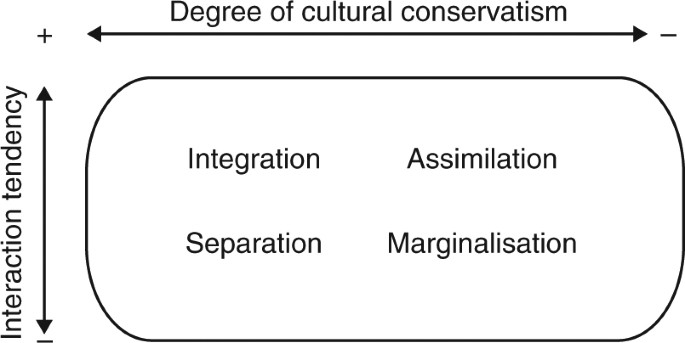
Berry's Four Acculturation Strategies and Research Evidence
Berry's Four Acculturation Strategies
- Integration: maintains heritage culture while also adopting aspects of the new culture (biculturalism). Associated with the best psychological outcomes.
- Assimilation: gives up heritage culture and fully adopts mainstream culture. May reduce stress short-term but can involve identity loss.
- Separation: maintains heritage culture while rejecting engagement with mainstream culture. May protect cultural identity but can result in social isolation.
- Marginalisation: maintains neither heritage nor mainstream culture. Associated with poorest psychological outcomes.
Research Evidence
Berry et al. (2006) conducted a large-scale study of immigrant youth across 13 countries (ICSEY), involving over 5,000 participants. They found that integration was the most common strategy and was associated with the best psychological adaptation, including life satisfaction, positive self-esteem, and lower psychological problems. Marginalisation was least common and associated with worst outcomes. However, outcomes were also influenced by the attitude of the receiving society — immigrant youth who experienced ethnic discrimination or lived in less multicultural host societies showed poorer psychological outcomes regardless of their own acculturation strategy.
Evaluation
Evaluation
Berry's model is influential and widely applied, providing a clear and practical framework. However, the model has been criticised for presenting acculturation as a matter of individual choice, when in reality the receiving society constrains available options. The model also implies that cultures are relatively fixed and separate, whereas in reality cultural contact produces hybrid identities that do not fit neatly into Berry's categories. Additionally, the model was developed primarily from research on voluntary immigrants and may not apply as well to refugees or involuntary migrants facing fundamentally different circumstances.
Practice Question
Question 2 — Short Answer
Outline two acculturation strategies identified by Berry (1997) and explain how each is associated with a different psychological outcome.
Command term — "Outline": Give a brief account or summary. Do not evaluate; simply describe each strategy and link it to a psychological outcome (e.g., acculturative stress, well-being, identity loss). Award 1 mark per strategy described + 1 mark per psychological outcome linked = 4 marks total.