Cognitive Dissonance
Cognitive Dissonance
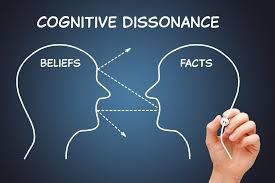
Cognitive dissonance is a state of psychological discomfort that arises when a person holds two or more cognitions (beliefs, attitudes, or knowledge) that are inconsistent with each other, or when they behave in a way that conflicts with their beliefs. The concept was introduced by Leon Festinger (1957), who argued that people are motivated to reduce this discomfort by changing one of the conflicting cognitions, adding new cognitions to rationalise the inconsistency, or reducing the importance of one of the conflicting beliefs.
Festinger and Carlsmith (1959)
Festinger and Carlsmith (1959)
Festinger and Carlsmith conducted a classic experiment on cognitive dissonance. Participants performed a tedious, repetitive task for an hour, then were asked to tell the next participant (actually a confederate) that the task was interesting and enjoyable. Some participants were paid USD 1 for this, while others were paid USD 20. Afterwards, all participants rated how much they had genuinely enjoyed the task. Counterintuitively, participants paid only USD 1 rated the task as more enjoyable than those paid USD 20.
Festinger and Carlsmith explained this using dissonance theory: those paid USD 20 had a clear external justification for lying (they were well-paid), so they experienced little dissonance — they lied for the money. Those paid only USD 1 had insufficient external justification for their lie, creating dissonance between their belief (‘the task was boring’) and their behaviour (‘I just told someone it was interesting’). To reduce this dissonance, they adjusted their attitude — convincing themselves the task was actually somewhat interesting. This is the paradox of insufficient justification: the smaller the reward, the greater the attitude change.
Cognitive Dissonance in Everyday Behaviour
Cognitive Dissonance in Everyday Behaviour
Cognitive dissonance operates widely in daily life. Smokers who know smoking causes cancer must manage dissonance between this knowledge and their continued smoking. Common dissonance-reduction strategies include dismissing the evidence (‘the studies are exaggerated’), adding consonant cognitions (‘I exercise, so it balances out’), or minimising the importance of health (‘I could be hit by a bus tomorrow anyway’). Post-purchase dissonance — the regret people feel after major purchases — leads people to seek information that confirms their decision was correct and avoid information that challenges it. This shows confirmation bias and cognitive dissonance often work together.
Evaluation
Evaluation
Cognitive dissonance theory has strong experimental support and explains a wide range of attitude-behaviour inconsistencies. However, Bem's (1967) self-perception theory proposed an alternative explanation for Festinger and Carlsmith's findings: people observe their own behaviour and infer their attitudes from it (‘I said the task was interesting for USD 1; I must have found it somewhat interesting’). This interpretation does not require positing an uncomfortable internal state. Cross-cultural research has also found that dissonance and the need to resolve it may be more pronounced in individualist cultures where consistency between private beliefs and public behaviour is valued more highly than in collectivist cultures.