Diathesis Stress Model
Diathesis-Stress Model
The diathesis-stress model is a framework for understanding how psychological disorders develop. It proposes that a disorder emerges from the interaction between a predispositional vulnerability (the diathesis) and environmental stress. The diathesis alone is not sufficient to produce a disorder; similarly, stress alone does not cause disorder in people without the relevant vulnerability. It is the combination of the two that produces illness.
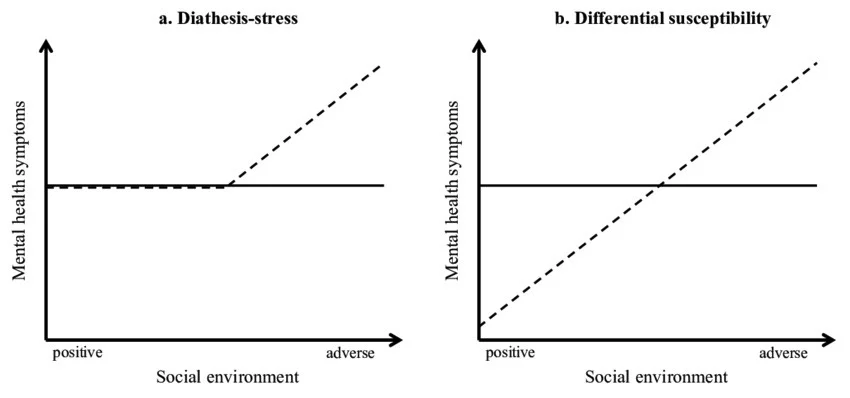
The Two Components
Diathesis: a pre-existing vulnerability that makes an individual more susceptible to developing a disorder. Diatheses may be genetic (carrying a variant of the 5-HTT gene), biological (an overreactive amygdala), or psychological (a ruminative cognitive style or low self-esteem).
Stress: environmental triggers — life events or chronic conditions that place demands on the individual's coping resources. Stressors can include bereavement, relationship breakdown, trauma, financial hardship, childhood adversity, or major life changes.
Research Evidence
Caspi et al. (2003) conducted a longitudinal study examining the interaction between the 5-HTT gene (short allele variant associated with lower serotonin transporter activity) and stressful life events in predicting depression. They followed over 1,000 New Zealand participants from birth to age 26. Participants who had the short allele of the 5-HTT gene and experienced multiple stressful life events were significantly more likely to develop depression than those with the long allele, or those with the short allele but low stress. This study is considered strong evidence for the gene-environment interaction at the heart of the diathesis-stress model.
Evaluation: The diathesis-stress model is valuable because it transcends the nature-nurture dichotomy, recognising that biology and environment work together. It helps explain why individuals with the same genetic makeup (such as identical twins) do not always develop the same disorders — because their environmental experiences differ. It also has practical implications: even when a diathesis cannot be changed, intervening to reduce stress or build coping resources can reduce the risk of disorder onset.
Limitations include difficulty in operationalising the diathesis concept, since it encompasses genetic, biological, cognitive, and situational factors. The model also focuses on vulnerability rather than resilience — some individuals exposed to both high diathesis and high stress do not develop disorders, and the model provides limited guidance on protective factors that might explain this. More integrative biopsychosocial frameworks have been developed to address these gaps.
Practice Question
Question 2.1 — Multiple Choice
Caspi et al. (2003) found that participants with the short allele of the 5-HTT gene who experienced multiple stressful life events were more likely to develop depression. Which model does this finding most directly support?
- A. Biological reductionism, because it demonstrates a genetic cause of depression
- B. The diathesis-stress model, because it shows an interaction between genetic vulnerability and environmental stress
- C. Social Learning Theory, because depression was observed across a large group
- D. The biomedical model, because SSRIs target the same gene variant
Answer: B. The diathesis-stress model, because it shows an interaction between genetic vulnerability and environmental stress