Cognitive Models
Cognitive Models
Cognitive models are theoretical frameworks that explain how mental processes operate. In psychology, a cognitive model typically represents how information is received, stored, transformed, and retrieved. Two of the most widely studied cognitive models are the Multi-Store Model of memory and the Working Memory Model, both of which explain memory as a system with distinct, interacting components.
Multi-Store Model: Atkinson and Shiffrin (1968)
Richard Atkinson and Richard Shiffrin proposed the Multi-Store Model (MSM), which describes memory as a series of three stores through which information passes sequentially.
Sensory memory: information from the environment first enters sensory stores (iconic for visual input, echoic for auditory input). This store has a very large capacity but an extremely short duration -- approximately 0.5 to 1 second. Most information decays here without further processing.
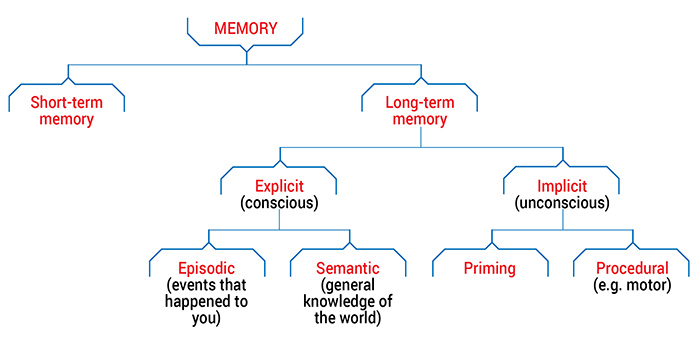
Short-term memory (STM): information that receives attention passes into STM, which has a limited capacity of approximately 7 plus or minus 2 items (Miller, 1956) and a duration of around 15 to 30 seconds without rehearsal. Information in STM is primarily encoded acoustically.
Long-term memory (LTM): through rehearsal, information is transferred from STM to LTM, which has unlimited capacity and duration. Information in LTM is primarily encoded semantically.
Supporting evidence comes from studies of the serial position effect -- the tendency to recall items from the beginning (primacy effect) and end (recency effect) of a list better than middle items. The primacy effect reflects transfer to LTM through rehearsal; the recency effect reflects information still in STM. Studies of patients with anterograde amnesia -- such as patient HM, who could not form new long-term memories following hippocampal surgery while retaining his existing LTM and intact STM -- provide strong biological support for the distinction between stores.
Working Memory Model: Baddeley and Hitch (1974)
Baddeley and Hitch argued that STM was not a single, passive store but an active system with multiple components they called working memory.
The Central Executive: a flexible, limited-capacity attention system that coordinates the other subsystems, allocates resources, and manages complex tasks.
The Phonological Loop: handles verbal and acoustic information through an inner ear (phonological store) and inner voice (articulatory rehearsal process). It is the system used when silently repeating a phone number.
The Visuospatial Sketchpad: processes and stores visual and spatial information, such as mental maps or the imagined layout of a room.
The Episodic Buffer (added in 2000): integrates information from the phonological loop, visuospatial sketchpad, and long-term memory into coherent episodes that have both temporal and spatial dimensions.
Evaluation: Both models are supported by experimental evidence and neuropsychological case studies. The working memory model is more comprehensive and flexible than the MSM because it acknowledges that STM is not passive but actively manipulates information. However, both models focus primarily on information processing and give limited attention to the role of emotion, motivation, and social context in memory. They are also primarily derived from laboratory tasks that may not fully capture how memory functions in real-life situations.
Practice Question
Question 1.1 — Multiple Choice
According to Baddeley and Hitch's Working Memory Model, which component is responsible for coordinating the other subsystems and allocating cognitive resources?
- A. The Phonological Loop
- B. The Visuospatial Sketchpad
- C. The Central Executive
- D. The Episodic Buffer
Answer: C. The Central Executive