Motion in electromagnetic fields
Motion in Electromagnetic Fields
In the previous lesson, we learned that electric and magnetic fields exert forces on charged particles. Now we explore what happens when particles actually move through these fields.
This isn’t just theoretical physics. When you watch an old cathode ray tube TV, you’re seeing electrons steered by electric and magnetic fields to paint images on the screen. When doctors use an MRI machine, they’re manipulating the motion of hydrogen nuclei in your body using powerful magnetic fields. When physicists discover new particles at CERN’s Large Hadron Collider, they’re accelerating protons to near light speed using electric fields and bending their paths with magnets.
Understanding how charged particles move in electromagnetic fields is the foundation for particle accelerators, mass spectrometers, particle detectors, electron microscopes, and countless other technologies.
Let’s explore how we can control particle motion using fields.
Motion in Electric Fields
F = qE = ma
a = qE/m
For a particle with charge q and mass m in a uniform electric field, the acceleration depends on the charge-to-mass ratio.
Linear Acceleration
qΔV = ΔKE = ½mv² - ½mu²
Starting from rest: v = √(2qΔV/m)
Example: An electron (m = 9.11 × 10⁻³¹ kg) is accelerated from rest through 1000 V. Find final speed.
v = √(2qΔV/m) = √[(2)(1.60 × 10⁻¹⁹)(1000)/(9.11 × 10⁻³¹)] = 1.87 × 10⁵ m/s (about 6% of light speed)
Deflection in Electric Fields
When a particle enters perpendicular to the field:
- Horizontal: constant velocity, x = v₀t
- Vertical: constant acceleration, a = qE/m, y = ½at² = ½(qE/m)t²
The path is parabolic (like projectile motion).
Example: Electron enters horizontally at 2.0 × 10⁵ m/s between plates with E = 5.0 × 10⁴ N/C. Plates are 0.10 m long. Find vertical deflection.
t = L/v₀ = 5.0 × 10⁻⁹ s
a = qE/m = (1.60 × 10⁻¹⁹)(5.0 × 10⁴)/(9.11 × 10⁻³¹) = 8.78 × 10¹⁵ m/s²
y = ½at² = ½(8.78 × 10¹⁵)(5.0 × 10⁻⁹)² = 0.110 m = 11.0 cm
Motion in Magnetic Fields
Magnetic forces are always perpendicular to velocity:
- Change direction but not speed
- Do no work
- Cannot change kinetic energy
Circular Motion in Magnetic Fields
qvB = mv²/r → r = mv/(qB) = p/(qB)
T = 2πm/(qB) (period)
f = qB/(2πm) (cyclotron frequency)
Example: A proton (m = 1.67 × 10⁻²⁷ kg) moves at 3.0 × 10⁶ m/s perpendicular to a 0.50 T magnetic field.
r = mv/(qB) = (1.67 × 10⁻²⁷)(3.0 × 10⁶)/[(1.60 × 10⁻¹⁹)(0.50)] = 0.063 m = 6.3 cm
T = 2πm/(qB) = 2π(1.67 × 10⁻²⁷)/[(1.60 × 10⁻¹⁹)(0.50)] = 1.31 × 10⁻⁷ s = 131 ns
Key insight: Period is independent of velocity! This property is exploited in cyclotrons.
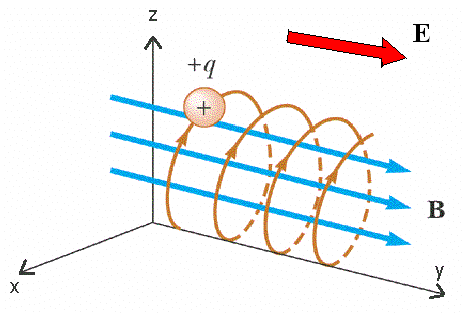
Helical Motion
If a particle enters at an angle to the field:
- Perpendicular component: Circular motion
- Parallel component: Uniform motion
Result: Helical (spiral) path around field lines.
This is why charged particles in Earth’s magnetic field spiral along field lines from pole to pole, creating auroras.
Velocity Selector
qE = qvB → v = E/B
Crossed electric and magnetic fields can filter particles by velocity. When forces balance, particles pass straight through undeflected.
Example: A velocity selector has E = 2.0 × 10⁴ V/m and B = 0.10 T. What velocity passes through?
v = E/B = (2.0 × 10⁴)/(0.10) = 2.0 × 10⁵ m/s
Mass Spectrometer
How it works:
- Ionization: Sample is ionized
- Acceleration: Ions accelerated through V → qV = ½mv²
- Velocity selection: Only ions with v = E/B pass through
- Magnetic deflection: Ions enter B-field → r = mv/(qB)
- Detection: Different masses hit detector at different positions
Radius: r = (1/B)√(2mV/q)
For singly-charged ions: r ∝ √m
Example: ²⁰Ne and ²²Ne isotopes accelerated through 1000 V, then enter B = 0.080 T. Find separation.
r₂₀ = 0.255 m, r₂₂ = 0.268 m
Separation = 2(r₂₂ - r₂₀) = 2.6 cm
Cyclotron: Particle Accelerator
Operation: Alternating electric field + constant magnetic field accelerate particles in a spiral path.
Key insight: Period T = 2πm/(qB) is independent of velocity — always in sync!
Maximum kinetic energy: KE_max = q²B²R²/(2m)
Example: A cyclotron with R = 0.50 m and B = 1.2 T accelerates protons.
KE = q²B²R²/(2m) = 17.3 MeV (mega electron volts)
Comparing Motions
| Situation | Path Shape | Energy Change | Key Formula |
|---|---|---|---|
| Uniform E (parallel to v) | Straight line | Increases/decreases | qΔV = ΔKE |
| Uniform E (perpendicular to v) | Parabola | Increases | a = qE/m |
| Uniform B (perpendicular to v) | Circle | No change | r = mv/(qB) |
| Uniform B (at angle) | Helix | No change | Circular + linear |
| Crossed E and B | Straight (if v=E/B) | Depends | Velocity selector |
Hall Effect
When current flows through a conductor in a magnetic field perpendicular to the current, charges deflect to one side, creating a voltage across the conductor (Hall voltage).
Applications:
- Measuring magnetic field strength
- Determining charge carrier type (positive or negative)
- Current measurement without breaking circuit
- Position sensors
Applications in Technology
Electric fields deflect electron beams to scan across screens
Identifies molecules in chemistry, biology, forensics
Accelerators like LHC use magnetic fields to steer particles
Magnetic "lenses" focus electron beams for high resolution
Strong magnetic fields align hydrogen nuclei for medical imaging
Spacecraft engines accelerate ions with electric fields
Why This Matters
Understanding particle motion in fields bridges theory and application. The same physics that explains electron behavior in atoms powers the technologies defining modern civilization.
From the screens you watch to the medical diagnostics that save lives, from discovering the Higgs boson to exploring the outer solar system with ion drives — it all comes down to controlling how charged particles move through electric and magnetic fields.