Receptors and hormones
Receptors and Hormones
Your body faces a constant challenge. Millions of cells spread across dozens of organs all need to coordinate their activities, respond to changes, and work together as a single integrated system. How does a cell in your kidney know what a cell in your pancreas is doing? How does your liver know when to release glucose? How does your body know when to grow?
The answer lies in two communication systems working alongside each other. The nervous system handles rapid, precise, short-lived signals. The endocrine system uses chemical messengers called hormones that travel through the bloodstream, delivering slower but longer-lasting instructions to cells throughout the body.
Understanding how these systems work begins with understanding receptors.
What Are Receptors?
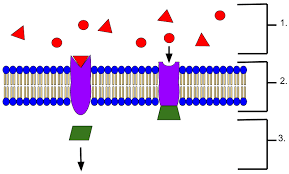
A receptor is a protein molecule that detects a specific stimulus and converts it into a signal that can be processed by the body.
Receptors exist at two levels:
- Sensory receptors are specialized cells or nerve endings that detect stimuli from the external or internal environment, such as light, sound, temperature, pressure, or chemicals. These are covered in detail in the Senses lesson.
- Cellular receptors are protein molecules embedded in or inside cell membranes that bind to specific chemical signals, including hormones and neurotransmitters. When a specific molecule binds to its receptor, it triggers a response inside the cell.
The specificity of receptors is crucial. Each receptor has a precise three-dimensional shape that only one type of molecule, or a small group of closely related molecules, can bind to. This is similar to the lock and key relationship between enzymes and substrates. A hormone circulating in the blood will only affect cells that carry the specific receptor it fits.
The Endocrine System
The endocrine system is the collection of glands and tissues that produce and secrete hormones directly into the bloodstream.
Unlike the nervous system, which uses electrical impulses along specific nerve pathways, the endocrine system broadcasts chemical messages through the blood to all parts of the body. Only cells with the appropriate receptor respond.
Hypothalamus
The hypothalamus is a region of the brain that links the nervous system to the endocrine system. It monitors internal conditions continuously and produces releasing hormones that control the pituitary gland.
Functions:
- Produces ADH (antidiuretic hormone) for water regulation
- Produces oxytocin for childbirth and bonding
- Produces releasing and inhibiting hormones that control the pituitary gland
- Acts as the master regulator of the endocrine system
Pituitary Gland
The pituitary gland sits just below the hypothalamus and is often called the master gland because it controls many other endocrine glands.
Anterior pituitary hormones:
- Growth hormone (GH): stimulates the growth of bones and muscles
- Thyroid-stimulating hormone (TSH): stimulates the thyroid to produce thyroxine
- Adrenocorticotropic hormone (ACTH): stimulates the adrenal cortex
- Follicle-stimulating hormone (FSH): stimulates follicle development in the ovaries, sperm production in the testes
- Luteinizing hormone (LH): triggers ovulation, stimulates sex hormone production
Posterior pituitary hormones (produced by the hypothalamus, stored here):
- ADH: increases water reabsorption by kidney tubules
- Oxytocin: stimulates uterine contractions during childbirth, milk release during breastfeeding
Thyroid Gland
Located in the neck, the thyroid produces thyroxine (T4) and triiodothyronine (T3).
Functions of thyroxine:
- Regulates metabolic rate throughout the body
- Essential for normal growth and development
- Regulates heart rate, body temperature, and energy use
Calcitonin is also produced by the thyroid and lowers blood calcium levels by inhibiting bone breakdown.
Disorders:
- Hypothyroidism: insufficient thyroxine, causing fatigue, weight gain, and slow metabolism
- Hyperthyroidism: excess thyroxine, causing rapid heart rate, weight loss, and anxiety
- Goiter: enlargement of the thyroid, often due to iodine deficiency
Parathyroid Glands
Four small glands are embedded in the thyroid. They produce parathyroid hormone (PTH).
Functions:
- Raises blood calcium levels by stimulating bone breakdown
- Stimulates calcium reabsorption by the kidneys
- Works antagonistically with calcitonin to regulate blood calcium precisely
Adrenal Glands
Two glands sitting on top of the kidneys, each with two distinct regions.
Adrenal medulla (inner region):
- Produces adrenaline (epinephrine) and noradrenaline in response to stress or danger
- Triggers the fight-or-flight response:
- Heart rate increases
- Breathing rate increases
- Blood glucose rises as glycogen is broken down
- Blood is diverted from the digestive organs to the muscles
- Pupils dilate
- Mental alertness increases
Adrenal cortex (outer region):
- Produces cortisol: regulates metabolism, suppresses inflammation, helps manage long-term stress
- Produces aldosterone: regulates salt and water balance by acting on the kidneys
Pancreas
The pancreas has both exocrine functions (producing digestive enzymes) and endocrine functions through clusters of cells called the islets of Langerhans.
- Beta cells produce insulin when blood glucose rises. Insulin stimulates cells to take up glucose and stimulates the liver to convert glucose to glycogen.
- Alpha cells produce glucagon when blood glucose falls. Glucagon stimulates the liver to break down glycogen and release glucose into the blood.
Together, insulin and glucagon maintain blood glucose within a narrow range through negative feedback, as detailed in the Homeostasis lesson.
Gonads
Testes
Produce testosterone in males. Testosterone:
- Stimulates the development of male secondary sexual characteristics at puberty
- Maintains sperm production
- Promotes muscle development and bone density
Ovaries
Produce estrogen and progesterone in females.
Estrogen:
- Stimulates the development of female secondary sexual characteristics at puberty
- Regulates the menstrual cycle
- Maintains bone density
Progesterone:
- Prepares and maintains the uterine lining for implantation
- Maintains pregnancy
- Works with estrogen to regulate the menstrual cycle
How Hormones Work
All hormones travel through the bloodstream but interact with target cells in different ways depending on whether they are water-soluble or lipid-soluble.
Water-Soluble Hormones
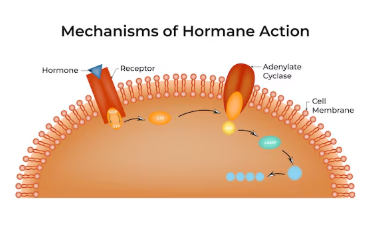
Water-soluble hormones, including peptide hormones like insulin and protein hormones like growth hormone, cannot pass through the hydrophobic lipid bilayer of the cell membrane.
They bind to receptor proteins on the surface of the target cell membrane. This binding triggers a signal transduction cascade inside the cell, producing a second messenger molecule such as cyclic AMP (cAMP) that relays the signal to enzymes and other proteins within the cell.
The hormone never enters the cell. It delivers its message from outside.
Lipid-Soluble Hormones
Lipid-soluble hormones, including steroid hormones like testosterone and estrogen, can dissolve in and pass directly through the cell membrane.
They bind to receptor proteins inside the cell, either in the cytoplasm or in the nucleus. The hormone-receptor complex then acts directly on DNA, binding to specific gene sequences and either activating or suppressing transcription of specific genes.
Steroid hormones, therefore, directly alter gene expression, which is why their effects tend to be slower in onset but longer-lasting than peptide hormones.
Feedback Mechanisms
Hormone secretion is carefully regulated to prevent overproduction or underproduction. The primary mechanism is negative feedback.
Negative Feedback
In a negative feedback system, the product of a hormonal response inhibits the further production of the hormone that caused the response.
Example: Thyroid hormone regulation
- Hypothalamus detects low thyroxine levels and releases thyrotropin-releasing hormone (TRH)
- TRH stimulates the pituitary to release TSH
- TSH stimulates the thyroid to produce thyroxine
- Rising thyroxine levels inhibit the hypothalamus and pituitary
- TRH and TSH production fall
- Thyroxine production decreases
- The system reaches equilibrium
This feedback loop maintains thyroxine within a precise range. The same principle operates for most endocrine glands.
Positive Feedback
In positive feedback, the response amplifies the original signal rather than opposing it. This is used in situations where a rapid, escalating response is needed.
Example: During childbirth, the baby's head pressing against the cervix stimulates oxytocin release from the pituitary. Oxytocin stimulates uterine contractions. Stronger contractions push the baby harder against the cervix, stimulating more oxytocin release. This positive feedback loop continues until birth, after which the stimulus is removed, and the loop ends.
Comparing Nervous and Endocrine Communication
| Feature | Nervous System | Endocrine System |
|---|---|---|
| Signal type | Electrical impulse | Chemical hormone |
| Transmission | Along nerve fibers | Through bloodstream |
| Speed | Very fast (milliseconds) | Slower (seconds to hours) |
| Duration of effect | Short-lived | Longer-lasting |
| Target | Specific cells at the synapse | All cells with an appropriate receptor |
| Examples | Reflex actions, muscle contraction | Growth, metabolism, reproduction |