Electron-pair sharing reactions
Electron-pair Sharing reactions
Have you ever wondered why water molecules are attracted to one another, or why you can easily dissolve table salt in water?
The answer to those questions begins at the atomic and subatomic levels. There are tiny particles, called electrons, that are not simply absent or floating at random places within the atom. Rather, they are responsible for the various interactions that determine how atoms bond to form molecules.
One of the fundamental interactions that promote atomic bonding are reactions involving the sharing of pairs of electrons (covalent bonding).
This learning unit will provide you foundational knowledge about covalent bonds and about more advanced concepts related to covalent bonds, such as polarity and the shapes of molecules.
What Is One Reaction Involving The Sharing Of Electron Pairs?
Covalent Bonds
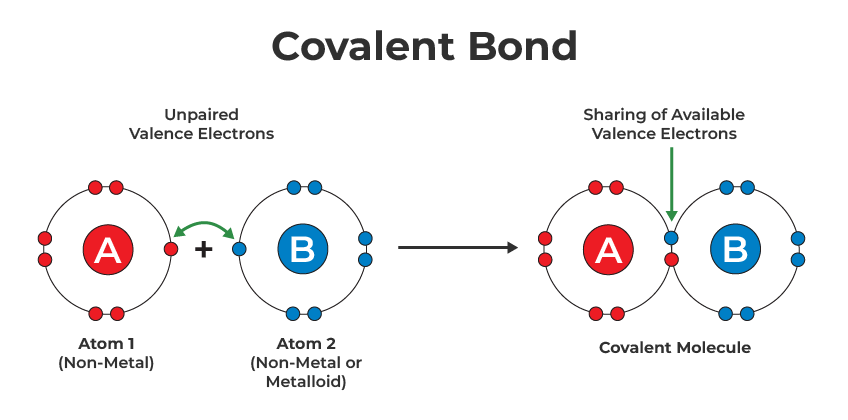
The chemical bonds that involve the sharing of electron pairs. This makes covalent bonds very strong and directional. This means the bond is specific from one atom to the other.
Types of Covalent Bonds:
The more pairs of covalent bonds, the shorter and stronger the bonds are.
Lewis Structures
Lewis structures are one of the simplest ways to represent covalent bonds. Each dot in your drawing is a valence electron. A covalent bond is illustrated as a line.
Example: Water (H₂O)
- An oxygen atom has 6 valence electrons.
- Each hydrogen atom has 1.
- Oxygen covalently bonds with 2 hydrogens.
- Oxygen has 2 lone pairs (unshared electrons) as well.
Lewis structures determine:
- Bonding patterns
- Lone pairs
- Molecular shape
- Electron pair geometry
Valence Shell Electron Pair Repulsion (VSEPR) Theory
The arrangement of a molecule’s shape is due to the repulsion of electron pairs. This phenomenon is known as the Valence Shell Electron Pair Repulsion (VSEPR) theory.
- Electron pairs around a central atom repel each other.
- In order to reduce the repulsive forces within the molecule, the entire molecule will adopt a shape that minimizes electron repulsion.
Examples:
Tip: Lone pairs repel bonding pairs more strongly, leading to a reduction in bond angle.
Polar and Nonpolar Covalent Bonds
The sharing of electron pairs in covalent bonds isn’t always equal. An atom’s ability to attract electrons is known as its electronegativity.
Polar covalent bond:
- Electrons are shared unequally.
- Example of Polar bond: H–Cl, oxygen pulls the electrons towards itself, which gives a partial positive charge to H and a partial negative to Cl.
Nonpolar covalent bond:
- Electrons are shared equally.
- Example of Nonpolar bond: H-H, Cl-Cl, and in hydrocarbons, C-H.
Polarity in Molecules:
- It’s essential to consider the overall shape of a molecule to decide if the molecule is polar, even if it has polar bonds.
- In CO₂, there are polar bonds present, and because of its linear shape, it is a nonpolar molecule.
- In H₂O, there are polar bonds and the overall shape is bent, hence a polar molecule.
Polarity influences:
- How well a substance dissolves in water
- The boiling and melting temperature
- Intermolecular forces present
Strength of Bonds and Bond Type
Covalent bonds are single, double, and triple. This leads to:
- Bond length: Single > double > triple
- Bond strength: Triple > double > single
This is the reason why the nitrogen triple bond (N≡N) is very stable and requires lots of energy to break.
Dative Covalent Bond / Coordinate Bond
In some cases, an atom donates both of the electrons in a bond. This is referred to as a coordinate bond.
Example: NH₄⁺
- In NH₃, nitrogen has a lone pair.
- The Hydrogen ion (H⁺) has no electrons.
- Nitrogen donates its lone pair to create an N–H⁺ coordinate bond.
Final Clarification: Even in normal covalent bonds, dative bonds act similarly in terms of strength and properties.
Intermolecular Forces
Covalently bonded molecules experience forces of attraction and repulsion between individual molecules and clusters of molecules called intermolecular forces. Covalent bonds are stronger than intermolecular forces, and these weaker forces determine physical properties of substances, such as boiling and melting points.
- Van der Waals Forces (London dispersion): All molecules.
- Dipole-dipole Interactions: Only between polar molecules.
- Hydrogen Bonding: Especially strong dipole-dipole; occurs when H is bonded to N, O, or F.
Example: Water has hydrogen bonding, and has a high boiling point compared to H₂S.
Reactivity of Covalent Compounds
Covalent compounds can react in a myriad of ways, depending on the type of bond.
- Addition Reactions: Common with double or triple bonds (alkenes/alkynes).
Example: C=C + H₂ → C–C - Substitution Reactions: One or more atoms or groups are replaced.
Example: CH₄ + Cl₂ → CH₃Cl + HCl - Condensation Reactions: Two molecules combine to form a more complex molecule or, in some cases, form water.
Example: Formation of esters in organic chemistry.
Key Idea: In reactions, the area of high electron density, such as lone pairs or π-bonds, are usually the site of reaction.
Summary
Memorizing the electron pair sharing reactions textbooks are filled with won’t help you. Instead, understanding the subject should aid in visualizing the reaction, the interaction of the atoms, and most importantly, the reason behind the properties of the molecules created by the reaction.
Why It Matters
- Due to covalent bonds, sharing of electrons are responsible for water molecules sticking together. Polarity of water molecules is another reason for the sticking.
- DNA, proteins, and carbohydrates are molecules responsible for life, and the covalent bonds in those molecules are what sustain life.
- Shared electrons reactions are what industrial chemistry relies on for the creation of plastics, fuels, and medicines.
With a firm grasp of this concept, you will be able to predict the shapes of molecules, have an understanding of the chemical reactions, and be able to design brand new molecules.
This module consists of sharing of electrons, covalent bonds, Lewis structures, shapes of molecules, polarity, intermolecular forces, and reactivity, as well as the chemistry syllabus for the International Baccalaureate (IB) program.