Cell respiration
Cell Respiration
Look around. You are breathing, your heart is beating, your brain is thinking, and your muscles are moving.
You may wonder, where does all this energy come from?
Food does provide us energy, but food is not directly usable by our cells. Your cells have to convert the food into chemical energy that is usable by the cell. That usable energy currency of the cell is called ATP.
Cell respiration is the process by which cells extract energy from organic molecules, primarily glucose, and convert it into ATP.
Life cannot exist without respiration.
What Is Cell Respiration?
Cell respiration is a series of chemical reactions that are largely controlled to break down the organic molecules to yield ATP.
Respiration is defined as:
- The controlled release of energy from organic compounds to produce ATP
- The organic compound that is primarily used is glucose.
Aerobic respiration occurs in the cell and requires the following chemicals to occur and to complete the cycle to produce energy for the cell (in the form of ATP) or to produce energy for the cell, the following equation is accomplished:
Glucose + Oxygen → Carbon dioxide + Water + Energy (in form of ATP)
In chemical equation form:
C₆H₁₂O₆ + 6O₂ → 6CO₂ + 6H₂O + ATP
Although the equation seems simple, a complex series of chemical reactions occurs in the cell in order to complete the process.
ATP – The Energy Currency
ATP is known as the energy currency of the cell and is known as the source of immediate energy for the cell. In the ATP molecule, there is a total of three phosphate groups. When one of the phosphate groups is removed, ATP becomes ADP (adenosine diphosphate) and energy is released.
ATP → ADP + Pi + Energy
The short answer is that ATP is used in the following processes:
- Active transport
- Muscle contraction
- Protein synthesis
- Nerve impulse transmission
- Cell division
The process of respiration is to regenerate ADP to ATP. Thus it is more accurate to say that the fuel source of the cell is ADP.
Types of Respiration
Respiration can be divided into two major processes:
Aerobic Respiration
To carry out Aerobic Respiration, one would need the following:
- Oxygen (this is the only major process that is different from Anaerobic Respiration).
- Aerobic Respiration occurs in the Mitochondria of the cell and releases a large number of ATP molecules.
Anaerobic Respiration
In contrast, Anaerobic Respiration occurs in the Cytoplasm of the cell, and as such releases a smaller amount of ATP molecules when compared to Aerobic Respiration.
In the case of humans, Anaerobic Respiration ultimately produces the molecule known as Lactate, whereas in the case of Yeast Anaerobic Respiration ultimately produces the molecules known as Ethanol and Carbon dioxide.
Structure of the Mitochondrion
The various steps of the process of Aerobic Respiration occur in the Mitochondria of the cell, and as such, it is known as the powerhouse of the cell.
A mitochondrion has five parts:
The folds of the mitochondria increase the surface area for important reactions. The inner membrane has some proteins that are critical for ATP production.
Stages of Aerobic Respiration
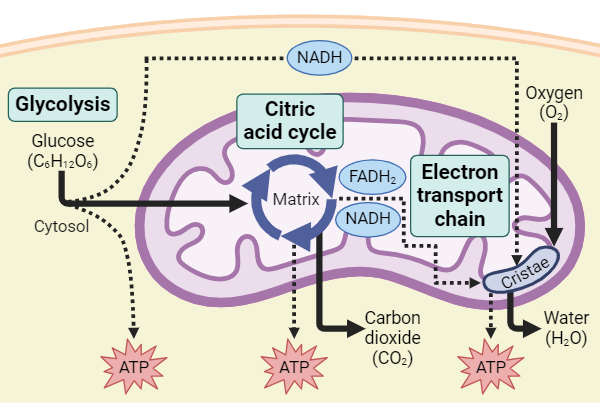
Aerobic respiration has four main parts:
Let us understand each step.
1. Glycolysis
Glycolysis takes place in the cytoplasm and does not need oxygen. A single glucose molecule (expected to have 6 carbons) gets broken down into two pyruvate molecules (3 carbons each). During this step in glycolysis:
- 2 ATP are used
- 4 ATP are produced
- This results in a net gain of 2 ATP
- 2 NADH are produced. NADH is used to transfer high-energy electrons to the later stages of respiration.
Glycolysis is the first step in both aerobic and anaerobic respiration.
2. Link Reaction
The Link Reaction acts as a bridge that connects Glycolysis to the Krebs Cycle. This takes place in the mitochondrial matrix.
Each pyruvate:
- Loses one carbon as CO₂
- Gets oxidized
- Combines with coenzyme A
The resulting product is called acetyl-CoA.
For one glucose molecule (which is broken down into 2 pyruvate molecules):
- 2 CO₂ are produced
- 2 NADH are produced
- 2 acetyl-CoA, which will later enter the Krebs cycle
3. Krebs Cycle
The Krebs Cycle is also called the citric acid cycle.
- Mitochondrial matrix is where it happens.
- Acetyl CoA (2 carbon) attaches to a 4-carbon chain to make a 6-carbon chain.
- After several reactions:
- 2 CO₂ leaves the cycle per turn
- NADH and FADH₂ are created
- A little ATP is created
For each cycle of glucose (2 turns of the cycle):
- 4 CO₂
- 6 NADH
- 2 FADH₂
- 2 ATP
At this point, the greatest amount of final energy is remaining in the NADH and FADH₂.
4. Electron Transport Chain (ETC)
This stage happens on the inner mitochondrial membrane.
This is the most crucial stage in terms of ATP yield.
- NADH and FADH₂ transport their electrons to the electron transport chain.
- The electrons are transferred sequentially to several protein complexes.
- As the electrons are transferred, a lot of energy is released.
- This energy is used to transport protons (H⁺) to the other side of the membrane, building a proton gradient.
- This gradient is what drives an ATP-producing enzyme (ATP synthase).
- This is called oxidative phosphorylation.
- At the end, oxygen is the final electron acceptor.
- Along with protons and electrons, it forms water.
In this part, the most ATP (about 28–34) is produced.
Total ATP Production
With aerobic respiration, this includes:
- Glycolysis → 2 ATP
- Krebs Cycle → 2 ATP
- Electron Transport Chain → 28-34 ATP
So, total ATP produced ≈ 32-38 (all cellular types)
Anaerobic Respiration
When oxygen is not available, anaerobic respiration kicks in.
In Humans
Pyruvate is converted into lactate. This leads to NAD being regenerated, and glycolysis can continue. When this occurs, only 2 ATP is produced per glucose molecule.
Lactate accumulation in muscles can also lead to fatigue.
In Yeast
Pyruvate is converted into ethanol and CO₂. This is called alcoholic fermentation.
While Anaerobic respiration can be fast, it is also very inefficient.
Role of Redox Reactions
In respiration, there are also oxidation and reduction reactions.
- When Oxidation occurs, there is a loss of electrons.
- When reduction occurs, there is a gain of electrons.
- Oxidation occurs with glucose, and reduction occurs with oxygen.
Carriers of electrons like NAD and FAD also play very important roles in respiration.
They safely transfer the energy in small steps, instead of it being released all at once.
Metabolic Pathways
Respiration is a metabolic pathway.
- In metabolic pathway, there is a series of reactions controlled by enzymes.
- Each step is catalyzed by a specific enzyme.
Enzymes:
- Lower activation energy
- Are specific
- Can be regulated
This ensures respiration is controlled and efficient.
Regulation of Respiration
Cells regulate respiration based on ATP demand.
- If there are high amounts of ATP generated in the cell, the processes in cellular respiration occur at a slower rate.
- Conversely, if there are low amounts of ATP, then the processes of cellular respiration speed up.
One of the most important regulatory enzymes of glycolysis is called phosphofructokinase. This enzyme increases the efficiency of cellular respiration by preventing the waste of cell energy.
Relationship With Photosynthesis
Photosynthesis and respiration are interdependent processes. The reactants for cellular respiration are the products of photosynthesis, which occur simultaneously within the cell.
Photosynthesis
Carbon dioxide + Water + Light → Glucose + Oxygen
Cellular Respiration
Glucose + Oxygen → Carbon dioxide + Water + ATP
This is how energy is transferred in an ecosystem.
Benefits of CELL RESPIRATION
Cellular respiration is important for the cellular processes of:
- Growth repair
- Movement
- Active transport
- Brain function
- Maintaining body temperature
Cellular respiration is the process by which ATP is generated. Without cellular respiration, the cellular processes come to a standstill, thereby causing inefficiency. Life, as we know it, depends on the continuous cycle of cellular respiration and energy generation.
The processes of cellular respiration may seem complicated, but they are based on clear principles.