Number and Algebra
UNIT 1: NUMBER & ALGEBRA
Practice questions covering rounding significant figures, standard form, arithmetic and geometric sequences and series, compound interest, loans, annuities, matrices, determinants, inverses, complex numbers (modulus, argument, polar form, De Moivre's theorem), Markov chains, and eigenvalues.
Round 0.003 472 to 2 significant figures.
Answer
0.0035
Write 0.000 056 7 in the form a × 10ᵏ, where 1 ≤ a < 10 and k ∈ ℤ.
Answer
5.67 × 10⁻⁵
An arithmetic sequence has first term u₁ = 5 and common difference d = 4. Find: (a) the 12th term, (b) the sum of the first 12 terms.
Answer
(a) u₁₂ = 49 (b) S₁₂ = 324
A geometric sequence has u₁ = 3 and common ratio r = 2. Write down u₅ and find the sum S₅.
Answer
u₅ = 48, S₅ = 93
A car bought for $24 000 depreciates at 15% per year. Find its value after 3 years, giving your answer to the nearest dollar.
Answer
24000 × (0.85)³ = $14 739
The approximate value of √2 is 1.41. The exact value is 1.41421… Calculate the percentage error in the approximation.
Answer
ε ≈ 0.298%
Evaluate Σ (k=1 to 6) of (2k + 3).
Answer
= 60
The nth term of an arithmetic sequence is given by uₙ = 3n − 7.
Answer
(a) u₁ = −4, d = 3 (b) n = 23 (c) S₂₅ = 800
A geometric sequence has u₁ = 64 and u₄ = 8.
Answer
(a) r = 0.5 (b) S∞ = 128 (c) n = 17
Francesca invests €8 500 at a nominal annual interest rate of 5.4%, compounded quarterly.
Answer
(a) €11 727.06 (b) 11 years
The first three terms of a geometric sequence are ln(2x+7), ln(2x+7)/3, ln(2x+7)/9.
Answer
(a) r = [ln(2x+7)/3] ÷ ln(2x+7) = 1/3 (b) Since |1/3| < 1, sum to infinity always exists (c) S∞ = (3/2)ln(2x+7)
Ahmed takes a loan of $15 000 at an annual interest rate of 6%, compounded monthly, to be repaid in equal monthly instalments over 4 years.
Answer
(a) $352.28/month (b) $16 909.44 (c) $1 909.44
Lucia deposits $250 at the start of each month into a savings account earning 3.6% per annum compounded monthly. She makes deposits for 8 years.
Answer
(a) FV ≈ $27 848.50 (b) $250 × 96 = $24 000
Consider the matrix equation AX = B where A = [[3, −1], [2, 4]] and B = [[7], [14]].
Answer
(a) det(A) = 14 (b) A⁻¹ = (1/14)[[4,1],[−2,3]] (c) x = 3, y = 2
Evaluate: Σ (r=3 to 10) of (5r − 2). Show all working using arithmetic series formulas.
Answer
244
A piece of equipment bought for $50 000 loses 20% of its value in the first year, then 15% per year after that. Find the value after (a) 1 year, (b) 5 years from new. Give answers to 3 s.f.
Answer
(a) $40 000 (b) $20 900 (3 s.f.)
The first term of an arithmetic sequence is −86 and common difference is 4.
Answer
(a) First positive term = 2, it is the 23rd term (b) Min Sₙ = −968
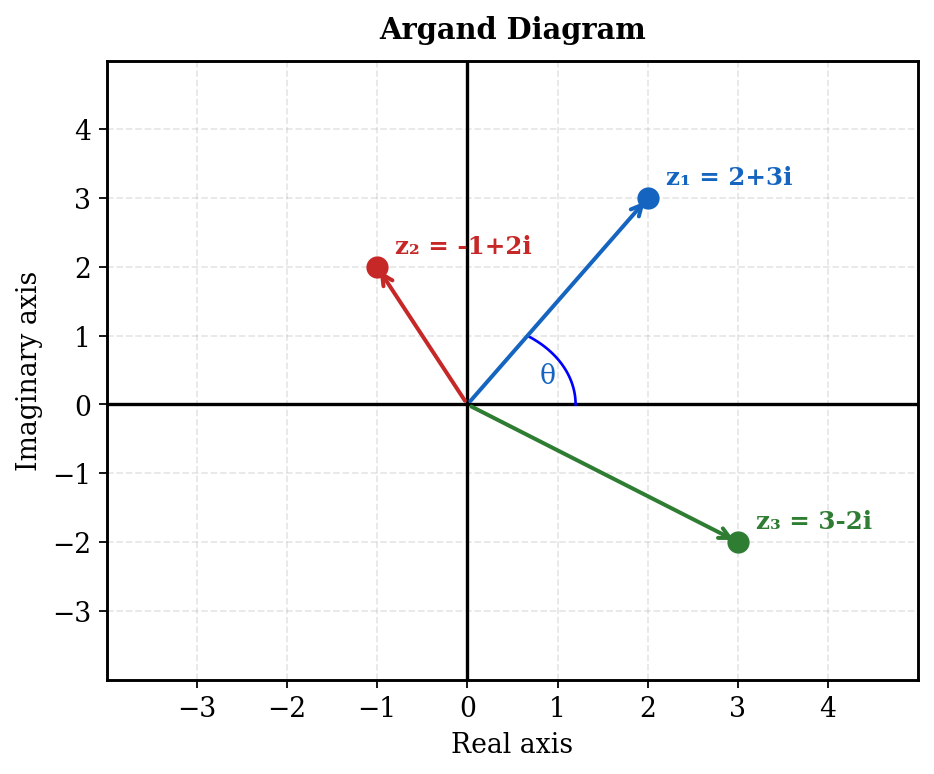
The Argand diagram shows three complex numbers z₁ = 2+3i, z₂ = −1+2i, and z₃ = 3−2i.
Answer
(a) |z₁|=√13≈3.606, arg=0.983 rad (b) √13·eⁱ⁰·⁹⁸³ (c) −8+i (d) 0+i = i
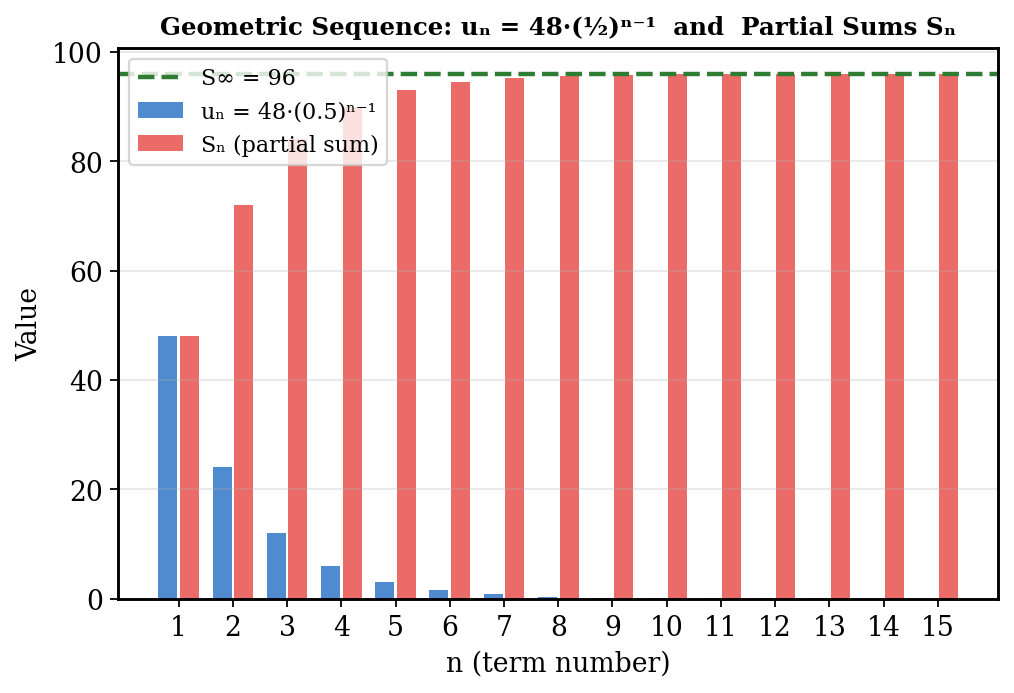
The graph shows the terms and partial sums of the geometric sequence uₙ = 48·(½)ⁿ⁻¹.
Answer
(a) 96 (b) n=8 (c) n=7 (d) −2
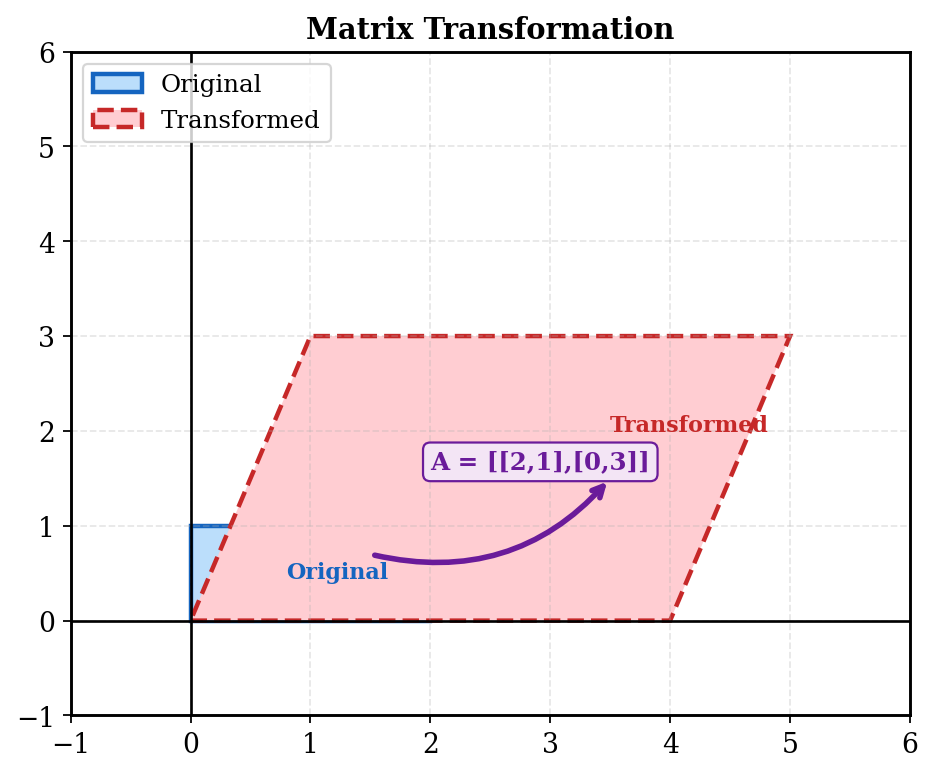
Matrix A = [[2,1],[0,3]] transforms the unit square as shown.
Answer
(a) λ=2 and λ=3 (b) v₁=[1,0]ᵀ, v₂=[1,1]ᵀ (c) P=[[1,1],[0,1]] (d) A⁵=[[32,211],[0,243]]
Complex number z = 1 + i.
Answer
(a) √2·eⁱᵖⁱ/⁴ (b) z⁸ = 16 (c) 2^(1/8)·eⁱ⁽ᵖⁱ/¹⁶⁺ᵏᵖⁱ/²⁾, k=0,1,2,3 (d) Shown
Solve the system of equations using matrices: 2x + y − z = 4, x − 2y + 3z = −6, 3x + 4y − 2z = 11.
Answer
(a) Written (b) det(A) = −15 (c) Computed via GDC (d) x=1, y=2, z=1
The first term of a sequence is u₁ = a and uₙ₊₁ = uₙ + d (arithmetic, d>0). Another sequence has v₁ = a and vₙ₊₁ = vₙ·r (geometric, r>1). Given: u₄ = v₃, u₈ = v₅, and a=2.
Answer
(a) 2+3d=2r², 2+7d=2r⁴ (b) Shown (c) r=2, d=6 (d) n=8
A pension scheme: Marco pays $400 at the start of each month into an account earning 4.8% per annum compounded monthly for 30 years.
Answer
(a) ≈$318 382 (b) ≈170 months (≈14.2 years) (c) Withdrawn $476K vs deposited $144K (d) $1273.53/month
A town has two internet providers: Aster (A) and Bolt (B). Each month, 20% of Aster customers switch to Bolt, and 15% of Bolt customers switch to Aster.
Answer
(a) [[0.80,0.15],[0.20,0.85]] (b) via GDC (c) ≈4286 Aster, 5714 Bolt (d) λ=1, λ=0.65