Geometry & Trigonometry - Practice Set 1
UNIT 3: GEOMETRY & TRIGONOMETRY
Practice questions covering cylinders, cones, pyramids, triangles (sine rule, cosine rule, area), sectors, vectors (dot product, cross product, lines, planes, angles), Voronoi diagrams, graph theory (Eulerian, Hamiltonian, MST, Dijkstra), 3D coordinates, trigonometric equations, geometric transformations, and more.
A right circular cylinder has radius 4 cm and height 9 cm. Find:
Answer
(a) V=144π≈452 cm³ (b) SA=104π≈327 cm²
In triangle ABC, angle A=90°, AB=5cm, AC=12cm. Find BC, angle B, and angle C.
Answer
BC=13 cm; B≈67.4°; C≈22.6°
A sector has radius 8 cm and angle θ = 1.2 radians. Find:
Answer
(a) 9.6 cm (b) 38.4 cm²
In triangle PQR, PQ=7, QR=10, angle Q=48°. Find PR using the cosine rule.
Answer
PR ≈ 7.42
Find the exact values of sin(60°), cos(30°), and tan(45°) using the unit circle.
Answer
sin(60°)=√3/2; cos(30°)=√3/2; tan(45°)=1
State the period and amplitude of:
Answer
(a) Period=π/2, amp=3 (b) Period=6π, amp=2
Vector a=[3,−1,2] and b=[−2,4,1]. Find:
Answer
(a) [1,3,3] (b) √14≈3.74 (c) −8
A pyramid has a square base of side 6m and vertical height 8m. Find:
Answer
(a) ≈8.54 m (b) ≈138.5 m² (c) 96 m³
In triangle ABC: a=9, b=12, c=7. Find:
Answer
(a) A≈48.2° (b) Area≈31.4 sq units
A Voronoi diagram has sites at A(0,0), B(4,0), C(2,4).
Answer
(a) x=2 (b) y=−x/2+5/2 (c) (2, 1.5) (d) Points nearer to A than any other site
Vector r = [2,−1,3] + λ[1,2,−1] is a line. Another line s = [0,3,1] + μ[2,1,1].
Answer
(a) θ=60° (b) System is inconsistent → lines are skew
Graph theory: A graph G has vertices {A,B,C,D,E} and edges {AB,AC,BC,CD,DE,AE}.
Answer
(a) A:3,B:2,C:3,D:2,E:2 (b) Not Eulerian (two odd-degree vertices) (c) B→A→C→D→E (d) Any spanning tree
A cone has base radius 5cm and slant height 13cm.
Answer
(a) 12 cm (b) ≈22.6° (c) 100π≈314 cm³ (d) r=2.5cm, h=6cm
From a boat, the angle of elevation to the top of a cliff is 28°. After moving 50m closer, the angle is 38°. Find the height of the cliff to the nearest metre.
Answer
h ≈ 116 m
The unit circle: P is a point at angle 5π/6.
Answer
(a) (−√3/2, 1/2) (b) sin=1/2, cos=−√3/2, tan=−√3/3 (c) θ=π/6, π/2, 5π/6, 3π/2
Two vectors: u=[2,3,−1] and v=[1,−2,4].
Answer
(a) [10,−9,−7] (b) Verified (c) √230≈15.2 sq units
In a 3D room, point A is at (1,0,0), B at (4,3,0), and C at (2,1,5) (all in metres).
Answer
(a) AB=[3,3,0], AC=[1,1,5] (b) ≈73.2° (c) ≈10.6 m²
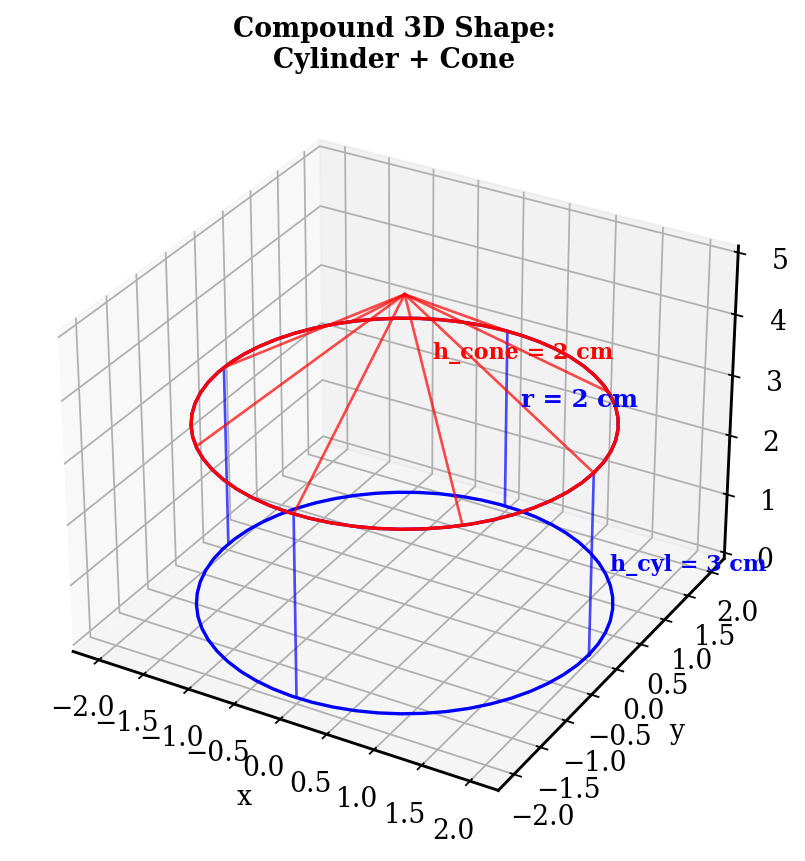
The diagram shows a compound 3D shape: a cylinder of radius r=2cm, height=3cm, topped by a cone of same base radius and height=2cm.
Answer
(a) 44π/3≈46.1cm³ (b) π(16+4√2)≈64.5cm² (c) 2√2≈2.83cm (d) k=∛5≈1.71
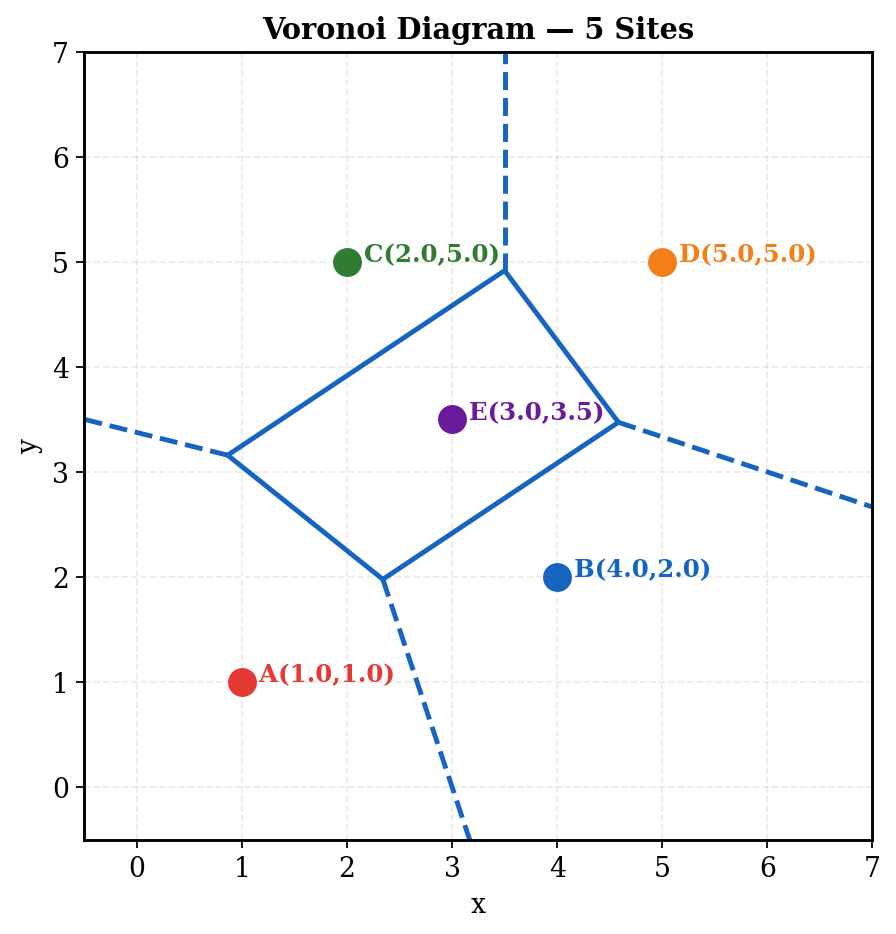
The Voronoi diagram shows 5 sites: A(1,1), B(4,2), C(2,5), D(5,5), E(3,3.5).
Answer
(a) y=−3x+9 (b) Site E (c) Circumcentre via GDC (d) New cell for F appears
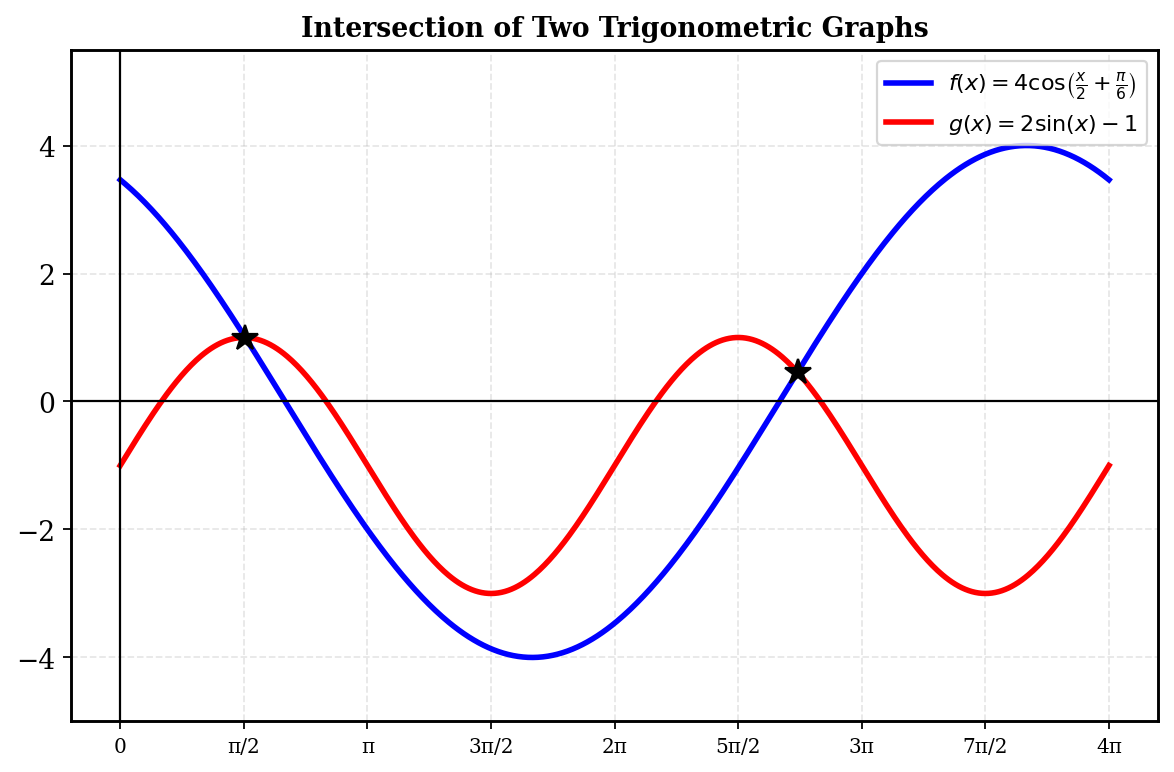
The graph shows f(x)=4cos(x/2+π/6) (blue) and g(x)=2sin(x)−1 (red) with intersection points marked ★.
Answer
(a) Amp=4, Period=4π, Phase=π/3 to the right (b) ≈1.05,3.50,7.33,9.78 (c) Via GDC (d) R=2, φ=0
Vector product applications: Line L₁: r=[1,2,3]+λ[2,1,−1] and Line L₂: r=[3,1,0]+μ[1,3,2].
Answer
(a) [1,−1,1] (b) Lines intersect (dist=0) (c) Plane via point+normal (d) Compute via GDC
A triangular prism has vertices: A(0,0,0), B(4,0,0), C(2,3,0), D(0,0,5), E(4,0,5), F(2,3,5).
Answer
(a) √41≈6.40 (b) ≈35.7° (c) 72 sq units (d) 10 units (by unfolding net)
Graph Theory: Weighted graph with vertices A,B,C,D,E and edges: AB=3, AC=5, BC=2, BD=6, BE=4, CD=7, DE=3, CE=8.
Answer
(a) MST: BC+AB+DE+BE=12 (b) Shortest A→E=7 (via B) (c) No (C,E odd degree) (d) ABCDE weight=23
Sine and cosine rule combined: In a quadrilateral ABCD (vertices in order): AB=6cm, BC=8cm, CD=5cm, DA=7cm, diagonal AC=9cm.
Answer
(a) ≈78.6° (b) ≈23.5cm² (c) ≈95.7° (d) ≈40.9cm² (e) ≈103.1°
Matrix M=[[0,−1],[1,0]] represents a rotation.
Answer
(b) (0,1),(0,3),(−2,2) (c) M⁴=I (identity/360°) (d) MN≠NM (y-axis vs x-axis reflection)