Functions - Practice Set 1
UNIT 2: FUNCTIONS
Practice questions covering lines, quadratics, domain and range, composite functions, inverse functions, transformations, perpendicular bisector, asymptotes, exponential and logistic models, sinusoidal models, piecewise functions, curve sketching, and more.
Find the gradient and y-intercept of the line 3x − 2y + 6 = 0.
Answer
Gradient = 3/2; y-intercept = (0, 3)
Line L passes through (2, −1) and (6, 7). Find the equation of L in the form y = mx + c.
Answer
m = (7−(−1))/(6−2) = 2; y−(−1) = 2(x−2) → y = 2x − 5
Given f(x) = 3x² − 2x + 1. Find: (a) f(0), (b) f(−2), (c) the axis of symmetry.
Answer
(a) 1 (b) 17 (c) x = 1/3
State the domain and range of f(x) = √(x − 3).
Answer
Domain: x ≥ 3 (i.e. [3,+∞)); Range: y ≥ 0 (i.e. [0,+∞))
Given f(x) = 2x + 1 and g(x) = x². Find (a) f∘g(x), (b) g∘f(x), (c) f∘g(3).
Answer
(a) 2x²+1 (b) (2x+1)² (c) 19
Find the inverse of f(x) = 4x − 7. State its domain and range.
Answer
f⁻¹(x) = (x+7)/4; Domain and range: all real numbers
Describe the transformations that map f(x) = x² onto g(x) = −(x+3)² + 5.
Answer
Translate left 3, reflect in x-axis, translate up 5
Line L₁ has equation 2x + 3y = 12. Line L₂ is perpendicular to L₁ and passes through (4, 1).
Answer
(a) m₁=−2/3 (b) y=1.5x−5 (c) (126/13, 3/13)
Find the perpendicular bisector of the segment joining A(1, 4) and B(7, −2). Write in the form ax + by = c.
Answer
Midpoint (4,1), slope=1, equation: x − y = 3
Consider f(x) = (x−2)/(x+1).
Answer
(a) x∈ℝ, x≠−1 (b) f⁻¹(x)=−(x+2)/(x−1) (c) x≠1 (d) x=−1, y=1
The exponential model P(t) = 1200·e^(0.03t) represents a population after t years.
Answer
(a) 1200 (b) ≈1619 (c) t≈36.6 years (d) 3% per year continuous growth rate
f(x) = 3sin(2x − π/4) − 1. Find: (a) amplitude, (b) period, (c) principal axis, (d) phase shift, (e) maximum and minimum values.
Answer
(a) 3 (b) π (c) y=−1 (d) π/8 right (e) Max=2, Min=−4
Use your GDC to solve 2x³ − 5x + 1 = 0, giving all solutions to 3 s.f.
Answer
x ≈ −1.66, x ≈ 0.201, x ≈ 1.46
f(x) = ln(2x−3).
Answer
(a) x>3/2, y∈ℝ (b) x-int=(2,0), VA: x=1.5 (c) f⁻¹(x)=(eˣ+3)/2
The graph of f(x) is transformed to g(x) = 2f(3x−6) + 4.
Answer
(a) Horizontal compression ×1/3, right 2; vertical stretch ×2, up 4 (b) Domain [2,4], Range [0,12]
The logistic function is P(t) = 500/(1 + 4e^(−0.2t)).
Answer
(a) 100 (b) 500 (c) t≈17.9 (d) At P=250, t≈6.93
Points A(1,3), B(5,7), C(8,2) form a triangle. Find:
Answer
(a) y=(3/5)x+12/5 (b) Centroid=(14/3, 4) (c) Circumcentre≈(4.5, 4.1)
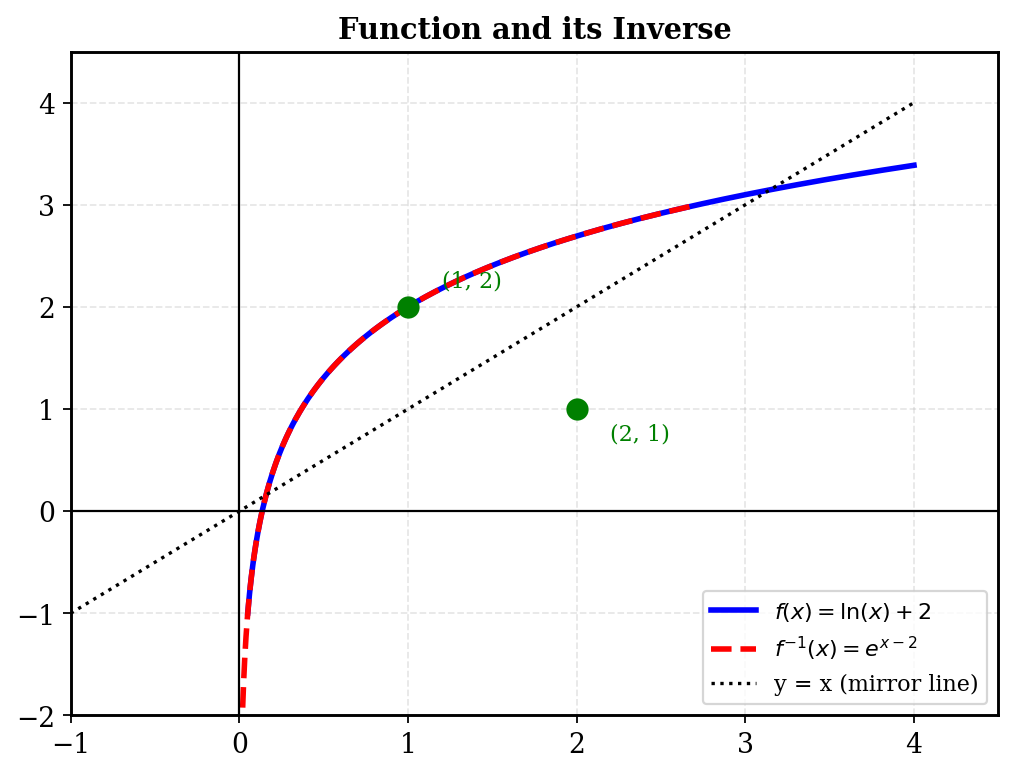
f(x) = ln(x) + 2 and its inverse f⁻¹(x) = e^(x−2).
Answer
(a) Verified (b) Solve numerically via GDC (c) e and 4 (d) x≈5.575
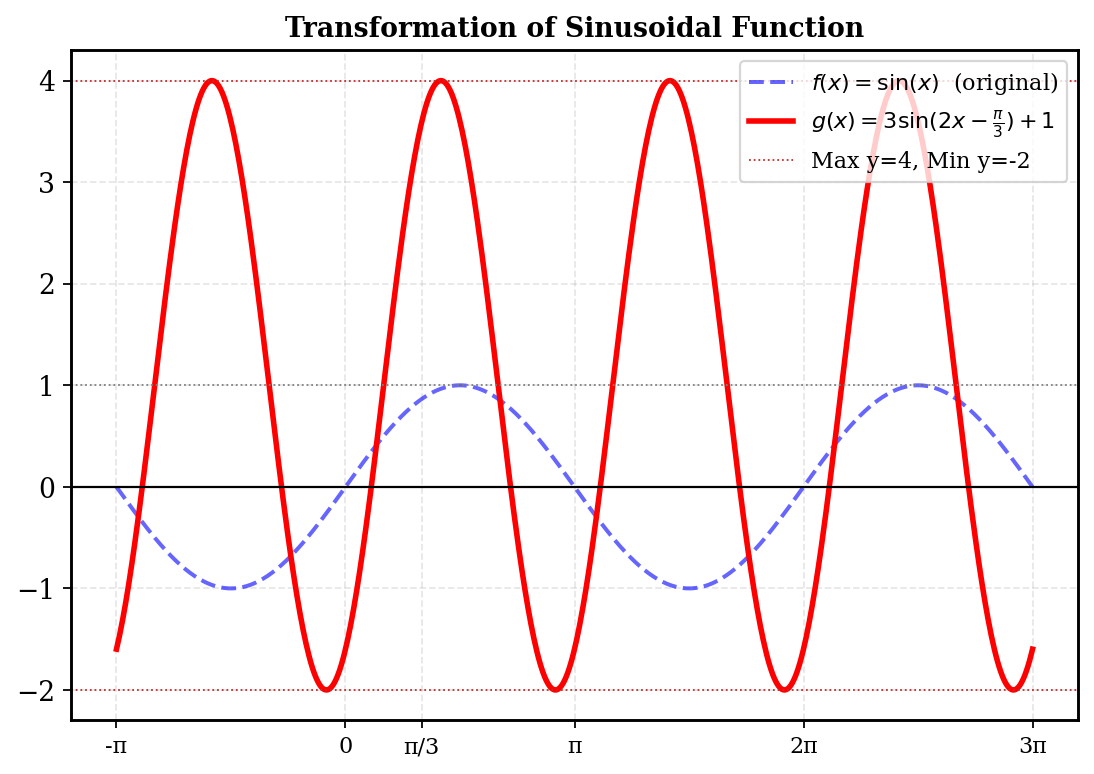
g(x) = 3sin(2x − π/3) + 1 and original f(x) = sin(x).
Answer
(a) Shown (b) Range [−2,4]; zeros at x≈0.71,1.34,3.85,4.48 (approx) (c) 6 (d) Via GDC
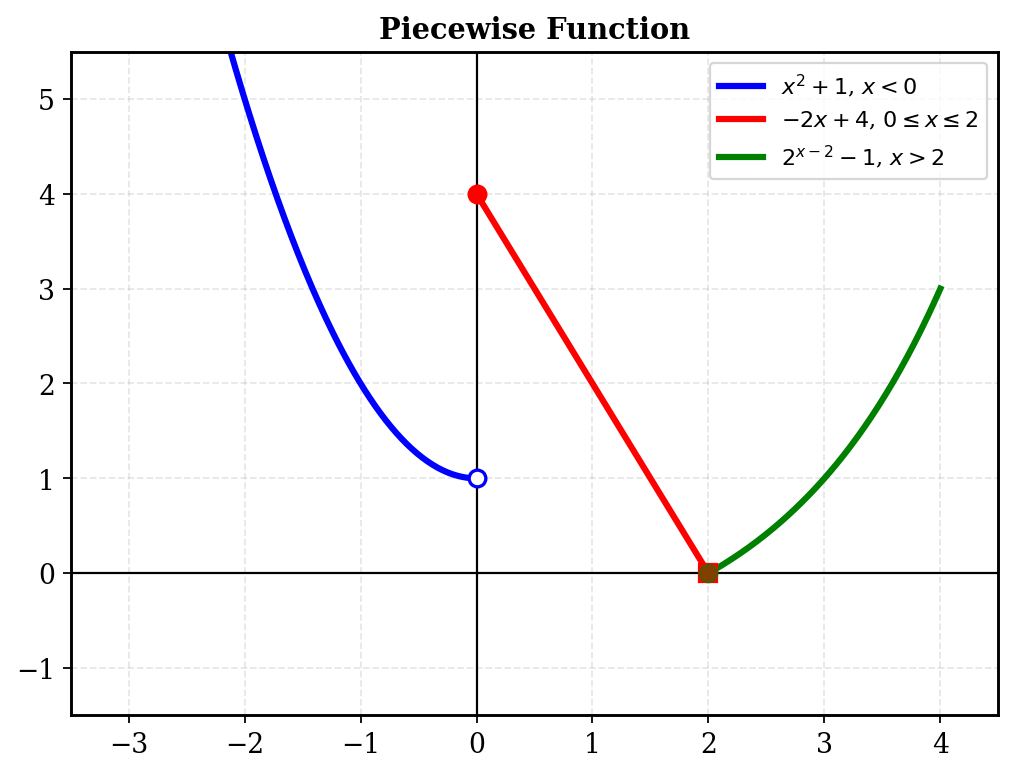
Piecewise function: for x<0: f(x)=x²+1; for 0≤x≤2: f(x)=−2x+4; for x>2: f(x)=2^(x−2)−1.
Answer
(a) Shown (lim=1≠f(0)=4) (b) x=2 (c) Domain ℝ, Range (−1,∞) (d) f⁻¹(x)=(4−x)/2, x∈[0,4] (e) 4
f(x) = (2x+a)/(bx+3) has a vertical asymptote at x=1 and passes through (0,2) and (2,5).
Answer
(a) b=−3 (b) a=6 (c) Verify with GDC (d) f⁻¹(x)=(3−3x)/(3x+2) (e) x=1±√(7/3) via GDC
Sinusoidal model: temperature T(t) = a·cos(bt) + d. Max 34°C at 2pm (t=14), min 18°C at 2am (t=2).
Answer
(a) a=8, d=26, b=π/12, period=24h (b) T(t)=8cos(π(t−14)/12)+26 (c) t≈8.9h and t≈19.1h (d) 26°C
Let f(x) = e^x and g(x) = 3x².
Answer
Answer not available — the source page was truncated at this question and will be completed later.