Calculus - Practice Set 1
UNIT 5: CALCULUS
Practice questions covering differentiation rules, tangents and normals, stationary points, integration (definite and indefinite), trapezoidal rule, substitution, areas between curves, volumes of revolution, kinematics, differential equations (separable, Newton's cooling), slope fields, Euler's method, optimization, and more.
Differentiate: (a) f(x)=5x³−3x²+7x−2,
Answer
(a) 15x²−6x+7 (b) 2/√x + 3/x² (c) 2e^(2x)
Find the equation of the tangent and normal to y=x²−3x+1 at the point where x=2.
Answer
Tangent: y=x−3; Normal: y=−x+1
Find:
Answer
(a) 2x³−2x²+3x+C (b) e^(3x)/3+C (c) ln|x|+C
Evaluate: ∫₁⁴ (3x − 2) dx.
Answer
16.5
f(x) = 2x³ − 9x² + 12x − 4
Answer
(a) 6x²−18x+12 (b) (1,1) max and (2,0) min (c) x=1 max, x=2 min
Use the trapezoidal rule with n=4 strips to estimate ∫₀² √(1+x²) dx.
Answer
≈2.977 (exact ≈3.056)
An object moves with velocity v(t) = 3t² − 6t + 2 m/s
Answer
(a) 0 m/s² (b) 6 m (c) t≈0.42 s and t≈1.58 s
f(x) = x·eˣ
Answer
(a) eˣ(1+x) (b) eˣ(2+x) (c) x=−2 (d) Min at x=−1
Use integration by substitution to find:
Answer
(a) (x²+3)⁵/5+C (b) −cos(3x+1)/3+C (c) eˣ²/2+C
Find the exact area enclosed between y=x² and y=6x−x². Show all working.
Answer
9 square units
f(x) = (2x+1)/(x−3). Find:
Answer
(a) −7/(x−3)² (b) y=−7x/4+47/4 (c) Strictly decreasing
Volume of revolution: the region bounded by y=√x, x=0, x=4, and the x-axis is rotated about the x-axis.
Answer
(a) V=π∫₀⁴x dx (b) 8π (c) 128π/5
A particle: s(t)=t³−6t²+9t+2 for t≥0
Answer
(a) v=3t²−12t+9, a=6t−12 (b) t=1,3 (c) 12 m (d) t=2
Separable ODE: dy/dx = y·cos(x)
Answer
(a) y=Ae^(sinx) (b) y=3e^(sinx) (c) 3e≈8.15 (d) y oscillates between ≈1.10 and 8.15
Find the dimensions of a rectangle with perimeter 40cm that has the maximum possible area. Use calculus to verify it is a maximum.
Answer
Square with side 10 cm; maximum area = 100 cm²
Euler's method: dy/dx=x+y, y(0)=1. Use step h=0.25 to estimate y(1).
Answer
y(1) ≈ 2.883 (exact: 2e−1≈4.436; Euler underestimates as f is concave up)
Find:
Answer
(a) x/2−sin(2x)/4+C (b) π/4 (c) −xcos(x)+sin(x)+C
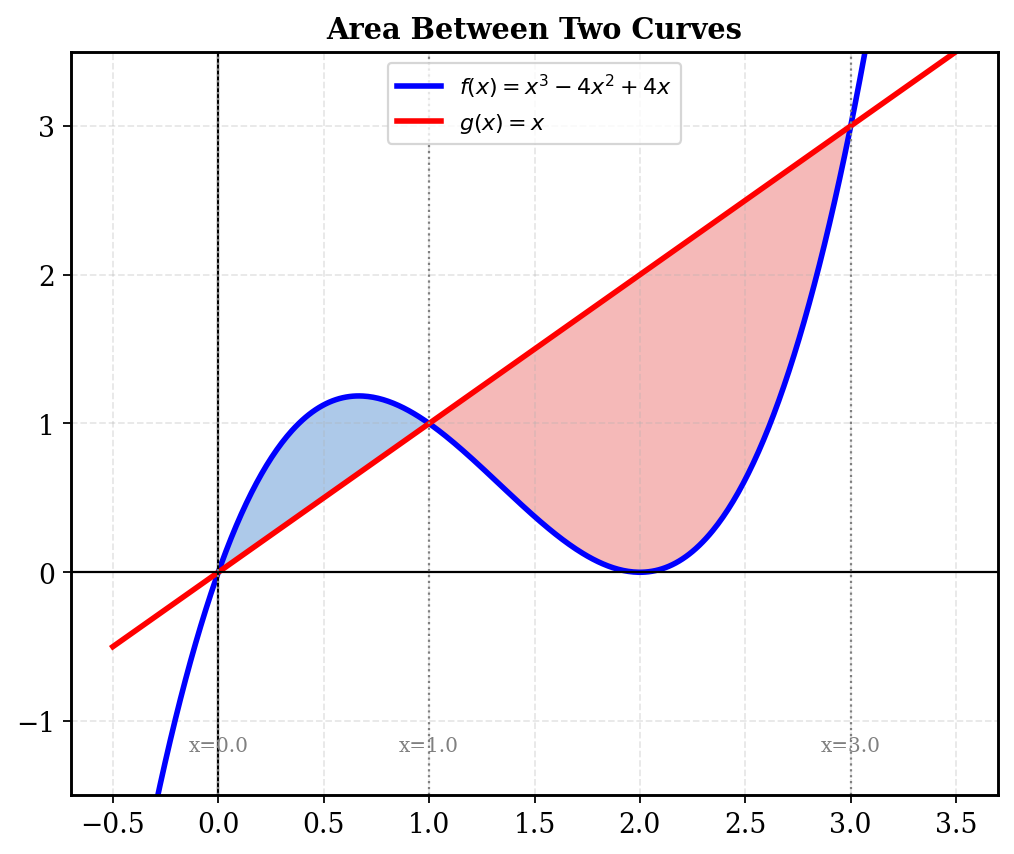
The diagram shows the area between f(x)=x³−4x²+4x (blue) and g(x)=x (red), with two shaded regions
Answer
(a) x=0,1,3 (b) f>g on [0,1]; g>f on [1,3] (c) 37/12 (d) 5/12+8/3=37/12
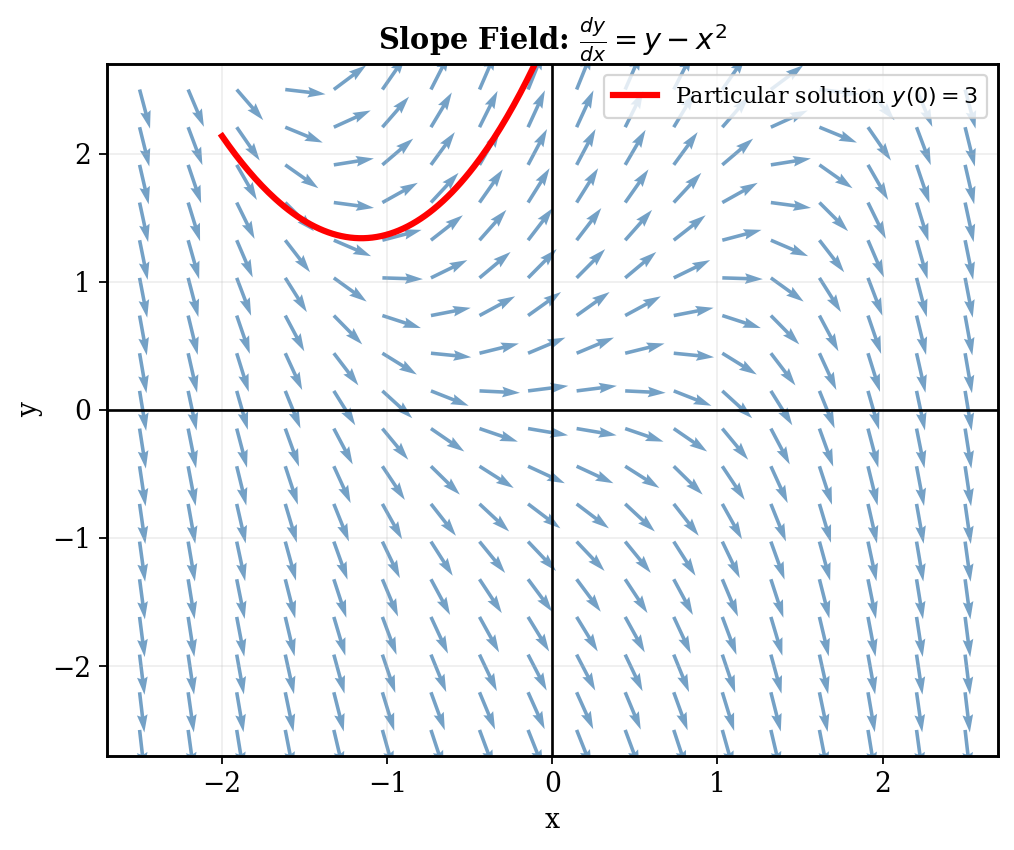
The slope field shows dy/dx=y−x². A particular solution with y(0)=3 is drawn.
Answer
(a) Verified (b) y(2)=e²+10≈17.4, slope≈13.4 (c) Euler gives ≈13.03, error≈4.36 (d) No equilibrium
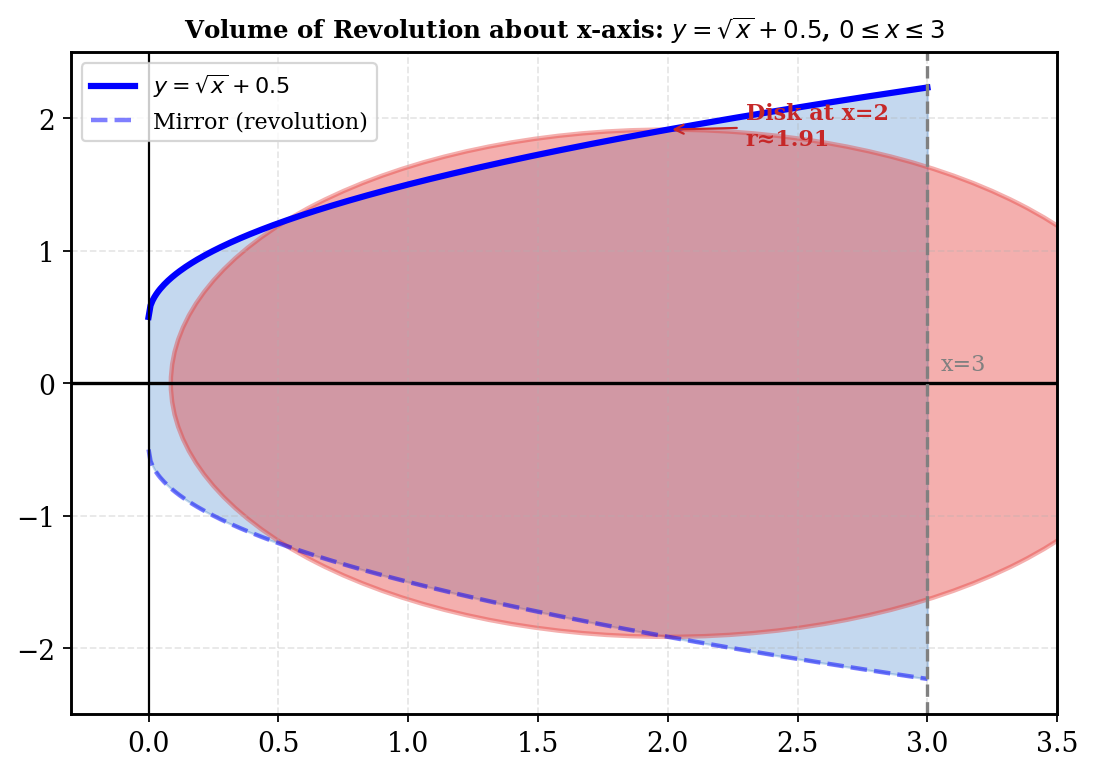
Volume of revolution: region bounded by y=√x+0.5, x-axis, x=0, x=3. The diagram shows a disk at x=2
Answer
(a) π∫₀³(√x+0.5)²dx (b) π(5.25+3√3)≈31.1 (c) ≈57.2 (d) SA≈47.3
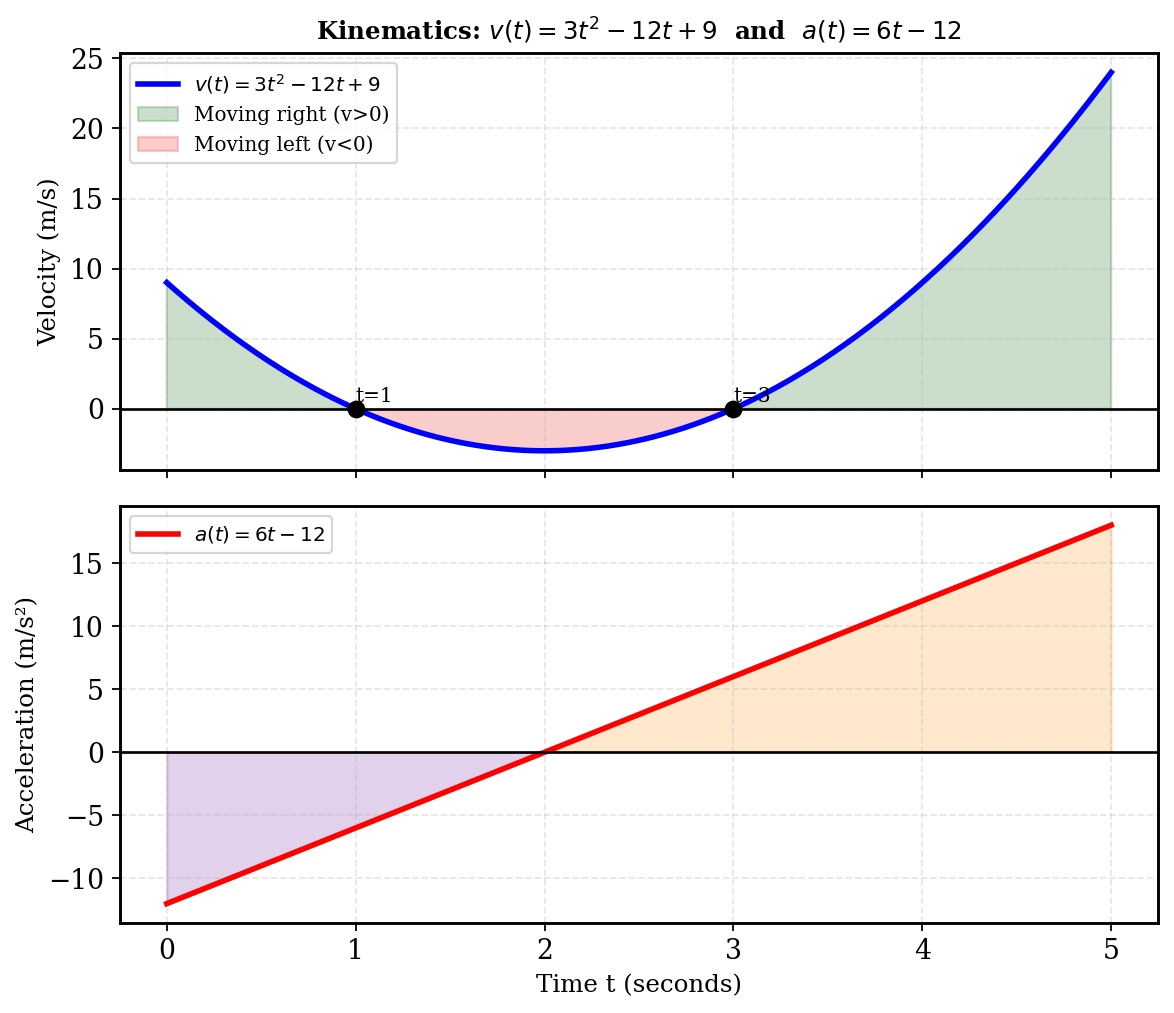
v(t)=3t²−12t+9 m/s (blue), a(t)=6t−12 m/s² (red) shown
Answer
(a) t=1,3; right,left,right (b) 28 m (c) 24 m/s at t=5 (d) Displacement=20m (e) t=3
Optimization (hard): An open-topped rectangular box is made from a 20cm×30cm sheet of metal by cutting squares of side x from each corner and folding up.
Answer
(a) Shown (b) V'=12x²−200x+600 (c) x=(25−5√7)/3≈3.93 (d) V''<0 (e) V≈1056 cm³
Differential equation application: Newton's Law of Cooling: dT/dt=−k(T−20), where T is temperature(°C), t is time(min), 20°C is room temp. A cup of coffee cools from 90°C to 70°C in 5 minutes.
Answer
(a) T=20+Ae^(−kt) (b) A=70 (c) k=ln(7/5)/5 (d) ≈38.2°C (e) ≈49.1 min (f) dT/dt=−k(T−25), T(10)=known
Further integration:
Answer
(a) x³lnx/3−x³/9+C (b) 8ln2/3−7/9 (c) −cos³x/3+C (d) 1/3 (e) ∫₀^(π/2)sin⁴x dx=3π/16
Coupled differential equations / Euler's method hybrid: A predator-prey model: dx/dt = 0.4x − 0.02xy (prey), dy/dt = −0.3y + 0.01xy (predator), where x=prey (hundreds), y=predator (tens). Initial: x(0)=40, y(0)=9
Answer
(a) (0,0) and (30,20) (b) Stable coexistence (c) x(1)≈49.1, y(1)≈10.1 (d) Both growing (e) Cyclic oscillations