Statistics & Probability - Practice Set 1
Statistics & Probability
Practice questions covering descriptive statistics, probability rules, binomial and normal distributions, conditional probability, Bayes' theorem, regression, correlation, hypothesis testing, confidence intervals, and continuous probability distributions.
The data set is: 4, 7, 3, 9, 2, 8, 5, 6, 7, 9.
Answer
(a) Mean = 60/10 = 6; Sorted: 2,3,4,5,6,7,7,8,9,9 → Median = (6+7)/2 = 6.5; Mode = 7 and 9 (b) Range = 9−2 = 7
P(A) = 0.4, P(B) = 0.5, P(A∩B) = 0.2.
Answer
(a) P(A∪B) = 0.4+0.5−0.2 = 0.7 (b) P(A|B) = 0.2/0.5 = 0.4
X ~ B(10, 0.3). Find:
Answer
(a) P(X=3) = C(10,3)(0.3)³(0.7)⁷ = 0.2668 (b) P(X≤2) = 0.3828 (c) E(X) = 3; Var(X) = 2.1
X ~ N(μ=50, σ=8). Find P(42 < X < 62).
Answer
z₁ = (42−50)/8 = −1, z₂ = (62−50)/8 = 1.5. P(−1 < Z < 1.5) = Φ(1.5) − Φ(−1) = 0.9332 − 0.1587 = 0.7745
A bag contains 5 red and 3 blue balls. Two are drawn without replacement.
Answer
(a) Tree: R(5/8)→R(4/7): RR, R→B(3/7): RB; B(3/8)→R(5/7): BR, B→B(2/7): BB (b) P(same) = (5/8)(4/7) + (3/8)(2/7) = 20/56 + 6/56 = 26/56 = 13/28
The regression line of y on x for a bivariate data set is y = 2.4x + 1.5. The mean of x is 5.
Answer
(a) ȳ = 2.4(5) + 1.5 = 13.5 (b) r = 0.95 indicates a strong positive linear correlation. (c) ŷ = 2.4(8)+1.5 = 20.7. Reliable if x=8 within data range (interpolation).
Events A and B are such that P(A)=0.6, P(B)=0.5 and P(A'∩B')=0.1.
Answer
(a) P(A∪B) = 1−0.1 = 0.9 (b) P(A∩B) = 0.6+0.5−0.9 = 0.2 (c) P(A)P(B)=0.3 ≠ 0.2 → NOT independent
X ~ N(μ, σ²). P(X < 60) = 0.8 and P(X < 45) = 0.25.
Answer
(a) (60−μ)/σ = 0.8416; (45−μ)/σ = −0.6745 (b) 15/σ = 1.5161 → σ = 9.89; μ = 60 − 0.8416(9.89) = 51.7
A discrete random variable X has distribution: x:1,2,3,4,5 with P(X):0.1,0.3,k,0.2,0.1.
Answer
(a) k = 0.3 (b) E(X) = 2.9; E(X²) = 9.7 (c) Var(X) = 1.29; SD = 1.136
X ~ N(μ=100, σ=15).
Answer
(a) z=1.33 → P=0.0918 (b) z=1.282 → x=119.2 ≈ 119 (c) Sample mean ~ N(100,9); z=1.667 → P≈0.0478
A factory produces lightbulbs with lifetimes X ~ N(1200, 100²) hours.
Answer
(a) z=1.5 → P=0.0668 (b) z=−1.645 → h=1035.5 hours (c) P(X>1000)=0.9772; Y~B(20,0.9772); P(Y≥18)≈0.928 (d) E=500×0.05=25 bulbs
Three boxes contain coloured balls: Box A: 3 red, 2 white; Box B: 1 red, 4 white; Box C: 2 red, 3 white. A box is chosen at random, then a ball is drawn.
Answer
(a) P(R) = (1/3)(3/5)+(1/3)(1/5)+(1/3)(2/5) = 6/15 = 2/5 (b) P(A|R) = (3/5)(1/3)/(2/5) = 1/2 (c) Bayes: P(A|R) = (3/15)/(6/15) = 1/2 ✓
A continuous random variable X has PDF: f(x) = kx(4−x²) for 0 ≤ x ≤ 2, and 0 otherwise.
Answer
(a) ∫₀² kx(4−x²)dx = 4k = 1 → k = 1/4 (b) F(x) = x²/2 − x⁴/16 (c) m²/2 − m⁴/16 = 0.5 → m ≈ 1.082
The heights of students follow a normal distribution. A sample of 8 students has heights: 165,170,172,168,175,162,178,169.
Answer
(a) x̄ = 169.875, s ≈ 5.17 (b) CI: 169.875 ± 2.365(5.17/√8) = (165.6, 174.2) (c) Sample size of 8 is small; may not represent full population well.
A disease affects 1% of a population. A test is 95% accurate (sensitivity) and 90% specific.
Answer
(a) Sensitivity = P(+|D)=0.95; Specificity = P(−|D')=0.90 (b) P(+) = 0.95(0.01)+0.10(0.99) = 0.1085 (c) P(D|+) = 0.0095/0.1085 ≈ 0.0876 ≈ 8.8% (d) Only ~8.8% chance of having disease despite positive test. False positives dominate.
Bivariate data: study hours (x) and exam score (y) for 6 students: x:2,3,5,6,8,9; y:40,50,65,70,80,85.
Answer
(a) r ≈ 0.991 (b) ŷ = 6.267x + 30.53 (c) ŷ(7)=74.4; Interpolation (7 within range 2-9)
A spinner has outcomes 1,2,3,4 with probabilities 0.1,0.2,0.3,0.4.
Answer
(a) 0.1+0.2+0.3+0.4=1 ✓ (b) E(X)=3, Var(X)=1 (c) T~N(300,100); P(T>310)=P(Z>1)=0.1587
Venn diagram: U=30 students. A={maths}=18, B={physics}=15, A∩B=8.
Answer
(a) A only:10, B only:7, both:8, neither:5 (b) P(A only)=10/30=1/3 (c) P(A|B')=10/15=2/3 (d) P(A)P(B)=0.3; P(A∩B)=0.267 ≠ 0.3 → not independent
Scores in a class test follow N(72,12²). Pass mark is 60.
Answer
(a) P(pass)=0.8413 (b) E(fail)=30×0.1587≈4.76 (c) P(Y=5)≈0.181 (d) z=−1.282 → p=72−15.4=56.6 → new pass mark≈57
Events A,B,C are mutually exclusive and exhaustive with P(A)=0.3,P(B)=0.45,P(C)=0.25. P(D|A)=0.4,P(D|B)=0.2,P(D|C)=0.6.
Answer
(a) P(D)=0.12+0.09+0.15=0.36 (b) P(B|D)=0.09/0.36=0.25 (c) P(A|D)=0.12/0.36=1/3; P(A'|D)=2/3
A machine makes bolts. 2% are defective. Bolts sampled in batches of 50.
Answer
(a) X~B(50,0.02); fixed n, independent, constant p, two outcomes (b) P(X=0)=0.364 (c) P(X>2)=1−P(0)−P(1)−P(2)=0.078 (d) 1−(0.99)ⁿ > 0.9 → n=230
X is a continuous random variable with PDF f(x) = ce^(−2x) for x ≥ 0.
Answer
(a) ∫₀^∞ ce^(−2x)dx = c/2 = 1 → c = 2 (b) P= e^(−2)−e^(−6) ≈ 0.132 (c) E(X)=1/2, Var(X)=1/4 (d) Exponential decay curve, starting at f(0)=2, decreasing toward 0.
In a school, 60% play sport, 45% study music, 25% do neither.
Answer
(a) P(S∩M)=0.6+0.45−0.75=0.30 (b) S only:0.30, M only:0.15, both:0.30, neither:0.25 (c) P(S only|at least one)=0.30/0.75=0.40
A manufacturer claims mean battery lifetime is 200 hours. Sample of 36 batteries has mean 195, SD=18.
Answer
(a) z = (195−200)/(18/6)=−1.667; |z|<1.96 → Fail to reject H₀. (b) Type I: Rejecting H₀ when μ=200. Type II: Not rejecting H₀ when μ≠200.
Scatter plot of 8 data points with positive linear trend. x:10,15,20,25,30,35,40,45; y:21,30,38,45,55,60,72,80.
Answer
(a) Σx=220, Σy=401, Σx²=7300, Σxy=12760 (b) a=1.386, b=12.01 → ŷ = 1.386x + 12.01 (c) For each additional unit of x, y increases by about 1.386. (d) r≈0.999 → very strong positive linear relationship.
The following table shows the Mathematics test scores (x) and the Science test scores (y) for a group of eight students.
| Mathematics scores (x) | 64 | 68 | 72 | 75 | 80 | 82 | 85 | 86 |
| Science scores (y) | 67 | 72 | 77 | 76 | 84 | 83 | 89 | 91 |
The regression line of y on x for this data can be written in the form y = ax + b.
Answer
(a) a=1.01, b=2.45 → ŷ = 1.01x + 2.45 (b) r=0.981 (c) ŷ(78)=1.01(78)+2.45≈81
The time worked T, in hours per week, is normally distributed with mean 42 and standard deviation 10.7.
A large group of employees work more than 40 hours per week.
It is known that P(a ≤ T ≤ b) = 0.904 and that P(T > b) = 2P(T < a), where a and b are numbers of hours worked per week. An employee who works fewer than a hours per week is considered to be a part-time employee.
Answer
(a) P(T>40)=0.574 (b) P=0.0444 (c)(i) 0.888 (c)(ii) 0.00245 (d) a≈22.2 hours/week
The mass M, in grams, of oranges is normally distributed with mean μ. The table below shows probabilities for values of M.
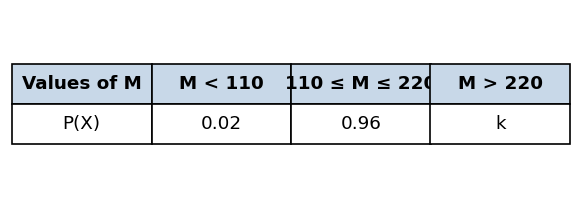
(ii) Show μ=165.
The oranges are packed in boxes of 15. Any orange with mass less than 120 g is classified as small.
A wooden crate contains 20 boxes of oranges.
(ii) Find the probability that at least 18 boxes contain at most 2 small oranges.
Answer
(a)(i) k=0.02 (a)(ii) μ=(110+220)/2=165 ✓ (b) P(M<120)=0.0832 (c) P(X≤2)≈0.736 (d)(i) E=20×0.736=14.7 (d)(ii) P(Y≥18)≈0.127
The time worked T, in hours per week, by employees is N(42, 10.7²).
It is known that P(a ≤ T ≤ b) = 0.904 and P(T > b) = 2P(T < a). An employee working fewer than a hours is part-time.
Answer
(a) 0.574 (b) 0.0444 (c)(i) 0.888 (c)(ii) 0.00245 (d) a≈22.2 hours
Three boxes contain coloured balls:
Box A: 3 red, 2 white. Box B: 1 red, 4 white. Box C: 2 red, 3 white.
A box is chosen at random, then a ball is drawn.
Answer
(a) P(R)=2/5 (b) P(A|R)=1/2 (c) Bayes: (3/15)/(6/15)=1/2 ✓
A manufacturer claims battery lifetime is N(200, 18²) hours. A sample of 36 batteries has mean 195 hours.
Answer
(a) z=−1.667, |z|<1.96 → Fail to reject H₀. (b) Type I: Reject when μ=200; Type II: Not reject when μ≠200. (c) p-value≈0.0956>0.05 → consistent with H₀.
A disease affects 1% of a population. A test has 95% sensitivity and 90% specificity.
Answer
(a) Sensitivity = P(+|D)=0.95; Specificity = P(−|D')=0.90 (b) P(+)=0.1085 (c) P(D|+)≈0.0876 ≈ 8.8% (d) Only ~9% chance of disease despite positive test. False positives dominate.
Mathematics scores (x) and Science scores (y) for 8 students:
x: 64, 68, 72, 75, 80, 82, 85, 86 y: 67, 72, 77, 76, 84, 83, 89, 91
Answer
(a) a≈1.01, b≈2.45 → ŷ=1.01x+2.45 (b) r≈0.981 (c) y≈81; Interpolation (78 within 64-86)
X ~ N(μ, σ²). P(X < 60) = 0.80 and P(X < 45) = 0.25.
Answer
(a) (60−μ)/σ=0.8416; (45−μ)/σ=−0.6745 (b) σ≈9.89, μ≈51.7 (c) P≈0.536
A discrete random variable X has the distribution: x = 1,2,3,4,5 with P(X=x) = 0.1, 0.3, k, 0.2, 0.1.
Answer
(a) k=0.3 (b) E(X)=2.9, Var(X)=1.29 (c) T~N(290,129); P(T>310)=P(Z>1.76)≈0.039
A continuous random variable X has PDF f(x) = kx(4 − x²) for 0 ≤ x ≤ 2, and 0 otherwise.
Answer
(a) k=1/4 (b) F(x)=x²/2 − x⁴/16 (c) m≈1.08 (d) E(X)=16/15≈1.07
A factory produces lightbulbs with lifetimes X ~ N(1200, 100²) hours.
Answer
(a) 0.0668 (b) h≈1035.5 hours (c) P≈0.929