Geometry & Trigonometry - Practice Set 1
Geometry & Trigonometry
Practice questions covering arc length, sector area, cosine rule, sine rule, trigonometric identities, solving equations, Ferris wheel applications, vectors, dot product, cross product, lines and planes, and vector proofs.
A sector of a circle has radius 8 cm and central angle θ = 2.5 radians.
Answer
(a) l = rθ = 8 × 2.5 = 20 cm (b) A = ½r²θ = ½ × 64 × 2.5 = 80 cm² (c) θ = 2.5 × (180/π) ≈ 143.2°
A triangle has sides a=7, b=9, and angle C=60°.
Answer
(a) c² = 49 + 81 − 2(7)(9)cos60° = 130 − 63 = 67 → c = √67 ≈ 8.19 (b) Area = ½ab·sinC = ½(7)(9)sin60° = 63√3/4 ≈ 27.3 cm²
Prove the identity: sin²θ + cos²θ = 1.
Hence prove tan²θ + 1 = sec²θ.
Answer
sin²θ + cos²θ = 1 (Pythagorean identity from unit circle definition). Divide throughout by cos²θ (cos θ ≠ 0): sin²θ/cos²θ + 1 = 1/cos²θ → tan²θ + 1 = sec²θ ✓
Solve for 0 ≤ x ≤ 2π: sin(x) = √3/2.
Answer
Principal value: x = π/3. Since sin is positive in Q1 and Q2: x = π/3 and x = π − π/3 = 2π/3
Sketch y = 2sin(x) + 1 for 0 ≤ x ≤ 2π. Label amplitude, period, and midline.
Answer
Amplitude = 2, Period = 2π, Midline: y = 1. y-intercept: (0, 1). Maximum: (π/2, 3). Minimum: (3π/2, −1). Graph: sinusoidal curve shifted up 1, vertically stretched by 2.
Solve for 0° ≤ θ ≤ 360°: 2cos²θ − cosθ − 1 = 0.
Answer
Let u = cosθ: 2u²−u−1 = 0 → (2u+1)(u−1) = 0. u = −1/2 or u = 1. cosθ = −1/2: θ = 120° or 240°. cosθ = 1: θ = 0° or 360°. All solutions: θ = 0°, 120°, 240°, 360°
In triangle ABC, AB = 10 cm, BC = 8 cm, angle BAC = 35°.
Answer
(a) sin(BCA)/10 = sin(35°)/8 → sin(BCA) = 10sin35°/8 = 0.717 → BCA ≈ 45.8° (b) ABC = 180°−35°−45.8° = 99.2° (c) AC/sin(99.2°) = 8/sin35° → AC = 8sin99.2°/sin35° ≈ 13.8 cm
Prove that (sinθ + cosθ)² − 1 = sin2θ.
Hence solve (sinθ+cosθ)² = 1.5 for 0 ≤ θ ≤ 2π.
Answer
(sinθ+cosθ)² = sin²θ + 2sinθcosθ + cos²θ = 1 + sin2θ. So (sinθ+cosθ)²−1 = sin2θ ✓. 1+sin2θ = 1.5 → sin2θ = 0.5. 2θ = π/6, 5π/6, 2π+π/6, 2π+5π/6 → θ = π/12, 5π/12, 13π/12, 17π/12
The graph of f(x) = a·sin(bx + c) has amplitude 3, period π, and passes through (π/6, 0) with positive gradient. Find a, b, and c.
Answer
Amplitude: a = 3. Period: 2π/b = π → b = 2. At x=π/6: 3sin(2·π/6 + c) = 0 → π/3 + c = nπ. Positive gradient at (π/6,0) means cosine term is positive: c = −π/3 + 2kπ. f(x) = 3sin(2x − π/3)
Two ships leave a port P at the same time. Ship A travels N30°E at 15 km/h. Ship B travels S60°E at 20 km/h.
Answer
(a) N30°E = 030°, S60°E = 120°. Angle between = 120°−30° = 90° (b) After 3h: A = 45 km, B = 60 km. Angle = 90°. Distance = √(45²+60²) = √(2025+3600) = √5625 = 75 km
A Ferris wheel has diameter 40 m. The centre is 25 m above ground. It rotates once every 50 seconds.
Answer
(a) At t=0: bottom → h = 25−20 = 5 m. Max = 45 m. Amplitude = 20, period = 50. h(t) = 25 − 20cos(2πt/50) = 25 − 20cos(πt/25) (b) 25 − 20cos(πt/25) = 40 → cos(πt/25) = −3/4 → πt/25 = arccos(−3/4) ≈ 2.419 → t ≈ 19.25 s. Also t ≈ 50−19.25 = 30.75 s; t ≈ 50+19.25 = 69.25 s; t ≈ 80.75 s. Solutions in 0 ≤ t ≤ 120: t ≈ 19.3, 30.8, 69.3, 80.8 s (c) Cosine shape, period 50, min at 5, max at 45, midline 25.
Solve the equation 3sin2θ = 2cosθ for 0 ≤ θ ≤ 2π.
Answer
3·2sinθcosθ = 2cosθ → 6sinθcosθ − 2cosθ = 0 → 2cosθ(3sinθ − 1) = 0. cosθ = 0: θ = π/2, 3π/2. sinθ = 1/3: θ = arcsin(1/3) ≈ 0.3398, π−0.3398 ≈ 2.8018. All solutions: θ ≈ 0.340, π/2, 2.802, 3π/2
In a triangle, a = 5 cm, b = 8 cm, c = 11 cm.
Answer
(a) cos A = (64+121−25)/(2·8·11) = 160/176 = 10/11 → A ≈ 24.6°. cos B = (25+121−64)/(2·5·11) = 82/110 → B ≈ 41.8°. C = 180°−24.6°−41.8° = 113.6° (b) Area = ½·5·8·sin(113.6°) = 18.3 cm² (c) R = a/(2sinA) = 5/(2sin24.6°) = 5/0.832 ≈ 6.01 cm
Diagram: Two buildings of different heights on flat ground. Building A is 50m tall. From the top of A, the angle of depression to the base of B is 30°, and the angle of elevation to the top of B is 20°. The buildings are d metres apart.
Answer
(a) tan30° = 50/d → d = 50/tan30° = 50√3 ≈ 86.6 m (b) Height added above A: d·tan20° = 86.6·tan20° ≈ 31.5 m → Height of B = 50 + 31.5 = 81.5 m (c) Angle of depression to base of A: arctan(81.5/86.6) ≈ 43.3° (d) Horizontal = 86.6 m, vertical diff = 31.5 m → Distance = √(86.6²+31.5²) ≈ 92.1 m
Prove the following identities:
Answer
(a) cos2θ = cos²θ−sin²θ = (1−sin²θ)−sin²θ = 1−2sin²θ ✓ (b) LHS = [sin²θ − (1−cosθ)²]/[sinθ(1−cosθ)] = [sin²θ−1+2cosθ−cos²θ]/[...] = 2cosθ(1−cosθ)/[sinθ(1−cosθ)] = 2cosθ/sinθ = 2cotθ ✓ (c) cos(π/6) = √3/2 = 1−2sin²(π/12) → sin²(π/12) = (1−√3/2)/2 = (2−√3)/4
Vectors: Let a = (2, −1, 3) and b = (1, 4, −2).
Answer
(a) a·b = 2−4−6 = −8 (b) |a| = √14, |b| = √21. cosθ = −8/(√14·√21) = −8/√294 ≈ −0.467 → θ ≈ 117.8° (c) a×b = |i j k; 2 -1 3; 1 4 -2| = (−10, 7, 9) (d) Plane through origin with normal (−10,7,9): −10x+7y+9z = 0
Line L₁ passes through A(1,2,0) with direction vector d₁=(1,1,2). Line L₂ passes through B(3,0,1) with direction vector d₂=(2,−1,1).
Answer
(a) L₁: (1+t, 2+t, 2t); L₂: (3+2s, −s, 1+s) (b) Setting equal leads to contradiction (s=−5/3, t=−1/3 but eq.1 fails) → lines are skew (do not intersect). (c) d₁×d₂ = (3,3,−3); AB = (2,−2,1). Distance = |AB·(d₁×d₂)|/|d₁×d₂| = |6−6−3|/√27 = 3/(3√3) = 1/√3 = √3/3
The plane Π₁ has equation 2x−y+3z=6. The line L has equation (x−1)/2 = (y+2)/1 = (z−3)/(−1).
Answer
(a) Parametric: x=1+2t, y=−2+t, z=3−t. Substitute into plane: 2+4t+2−t+9−3t=6 → 13=6? No → L is parallel to Π₁. (b) Line direction: (2,1,−1). Normal: (2,−1,3). sinθ = |d·n|/(|d||n|) = 0 → θ=0 → line parallel to plane. (c) Foot = P − [(2·4−0+3·2−6)/(4+1+9)]·(2,−1,3) = (4,0,2) − (8/14)·(2,−1,3) = (20/7, 4/7, 2/7)
Diagram: A person stands at point A on flat ground, looks up at a vertical pole BC at angle of elevation 40°. She walks 20 m toward the pole to point D and the angle of elevation is now 65°.
Answer
(a) [Diagram: A and D on ground, D is 20m from A toward base C. BC is vertical pole.] (b) Let BC = h, DC = x. Then AC = x+20. tan65° = h/x → h = x·tan65°; tan40° = h/(x+20) → h = (x+20)·tan40° (c) x·tan65° = (x+20)·tan40° → x(tan65°−tan40°) = 20·tan40° → x = 20tan40°/(tan65°−tan40°) ≈ 12.86 m → h = 12.86×tan65° ≈ 27.6 m (d) AC = x+20 = 32.86 m
The function f(θ) = asin(θ) + bcos(θ) can be written as R·sin(θ + φ).
Answer
(a) R·sin(θ+φ) = R·sinθcosφ + R·cosθsinφ. Comparing: Rcosφ = a and Rsinφ = b. R² = a²+b² → R = √(a²+b²). tanφ = b/a. ✓ (b) R = √(9+16) = 5. tanφ = 4/3 → φ = arctan(4/3) ≈ 0.927 rad. f(θ) = 5sin(θ + 0.927) (c) Maximum = 5, occurs when θ+0.927 = π/2 → θ = π/2−0.927 ≈ 0.644 rad.
A sector OAB has radius r=12 cm and area 60 cm².
Answer
(a) A = ½r²θ = 60 → ½(144)θ = 60 → θ = 60/72 = 5/6 rad. (b) Perimeter = 2r + arc = 24 + rθ = 24 + 12(5/6) = 24 + 10 = 34 cm. (c) Area of triangle OAB = ½r²sinθ = ½(144)sin(5/6) ≈ 72×0.7174 ≈ 51.7 cm². Area of segment = area of sector − area of triangle = 60 − 51.7 = 8.3 cm².
Prove the following:
Answer
(a) Consider unit vectors u=(cosA,sinA) and v=(cosB,sinB). |u−v|² = 2−2(cosAcosB+sinAsinB). Also |u−v|² = 2−2cos(A−B). So cos(A−B) = cosAcosB+sinAsinB. Replace B by −B: cos(A+B) = cosAcosB−sinAsinB ✓ (b) cos2A = cos(A+A) = cos²A−sin²A = 2cos²A−1 (c) 2cos²(π/6)−1 = cos(π/3). cos(π/6) = √3/2 → 2(3/4)−1 = 1/2 = cos(π/3) ✓
The vector equation of line L is r = (1,2,−1) + t(2,−1,3). Plane Π has equation x + 2y − z = 4.
Answer
(a) Parallel plane: x+2y−z = 3+2−2 = 3. Equation: x+2y−z=3. (b) Distance = |4−3|/√(1+4+1) = 1/√6 = √6/6. (c) Intersection point Q = (7/3, 4/3, 1). Reflect point (1,2,−1) in Π: foot of perpendicular = (2/3, 4/3, −2/3). Reflection = (1/3, 2/3, −1/3). Reflected line passes through (1/3,2/3,−1/3) with direction (2,−1,3).
In a quadrilateral ABCD, AB=5, BC=7, CD=6, DA=4, and angle ABC=100°.
Answer
(a) AC² = 25+49−2(5)(7)cos100° = 74+12.17 = 86.17 → AC ≈ 9.28 cm (b) Area of ACD = ½·4·6·sinADC = 10 → sinADC = 10/12 = 5/6 → ADC ≈ 56.4° (c) Area of ABC = ½·5·7·sin100° ≈ 17.25 cm². Total area = 17.25 + 10 = 27.25 cm²
Let z₁ = 1 + i and z₂ = √3 + i.
Answer
(a) z₁: |z₁|=√2, arg=π/4 → z₁ = √2·cis(π/4). z₂: |z₂|=2, arg=π/6 → z₂ = 2·cis(π/6). (b) z₁z₂ = 2√2·cis(5π/12). Direct: (1+i)(√3+i) = √3−1+(√3+1)i → matches. (c) (z₁)⁸ = (√2)⁸·cis(8π/4) = 16·cis(2π) = 16·1 = 16.
The following diagram shows a circular crop field. The circle has centre O and radius 400 m, and the points A, B, and C lie on the circle. The angle AOB = 1.6 radians.
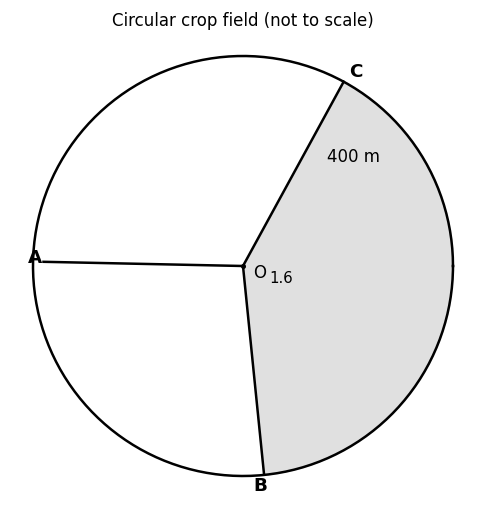
The angle BOC = 2.5 radians.
The shaded region is to be planted with corn. Corn seeds are sold in bags costing $140 each. One bag seeds 8960 m².
Answer
(a) AB = 2 × 400 × sin(0.8) ≈ 573 m (b) Area △AOB = ½ × 400² × sin(1.6) ≈ 77 550 m² (c) Arc AC: angle AOC = 2π − 1.6 − 2.5 = 2.183 rad (minor arc) → l = 400 × 2.183 ≈ 873 m (d) Area shaded = Area sector BOC − Area △BOC = ½(400²)(2.5) − ½(400²)sin(2.5) = 200 000 − ½(160 000)(0.5985) ≈ 200 000 − 47 880 ≈ 152 120 m² (e) Number of bags = ⌈152120/8960⌉ = 17 bags; Cost = 17 × $140 = $2380
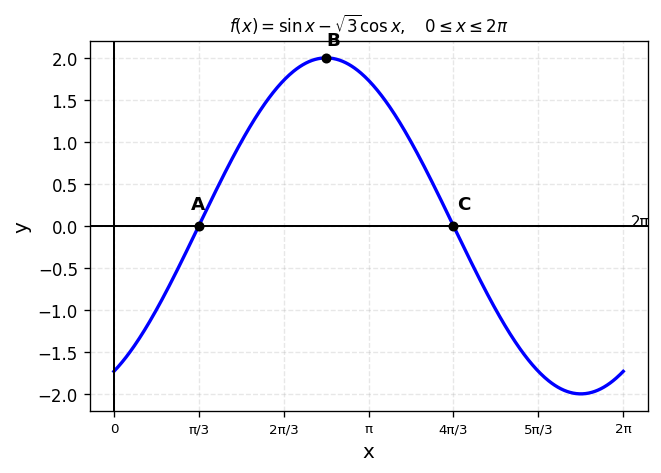
Let f(x) = sin x − √3 cos x, 0 ≤ x ≤ 2π.
The following diagram shows the graph of f(x). The curve crosses the x-axis at A and C and has a maximum at point B.
Answer
(a) sin x = √3 cos x → tan x = √3 → x = π/3 or x = 4π/3. A = (π/3, 0), C = (4π/3, 0) (b) f'(x) = cos x + √3 sin x (c) f'(x)=0: cos x + √3 sin x = 0 → tan x = −1/√3 → x = 5π/6. f(5π/6) = sin(5π/6) − √3 cos(5π/6) = ½ + 3/2 = 2 → B = (5π/6, 2)
Consider the functions f and g defined on the domain 0 < x < 2π by f(x) = 4 cos 2x and g(x) = 2 − 8 cos x.
The following diagram shows the graphs of y = f(x) and y = g(x).
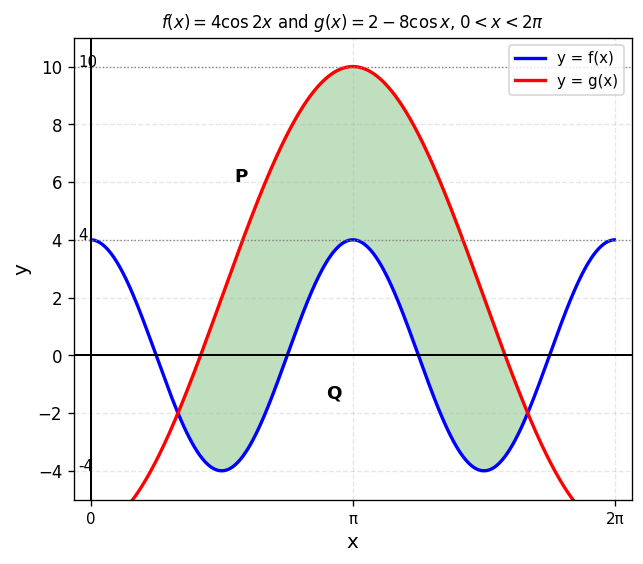
At points P and Q, the gradients of the two graphs are equal.
Answer
(a) 4cos2x = 2−8cosx → 8cos²x−4 = 2−8cosx → 8cos²x+8cosx−6=0 → 4cos²x+4cosx−3=0 → (2cosx+3)(2cosx−1)=0 → cosx=1/2. Intersections at x = π/3, 2π/3, 4π/3, 5π/3 (b) Area = 2π + 6√3 (exact) (c) f'(x)=−8sin2x, g'(x)=8sinx; −8sin2x = 8sinx → −16sinxcosx = 8sinx → cosx = −1/2 (sinx≠0) → x = 2π/3 or 4π/3. P on upper part: g(2π/3) = 2 − 8(−1/2) = 6 → y-coordinate of P = 6
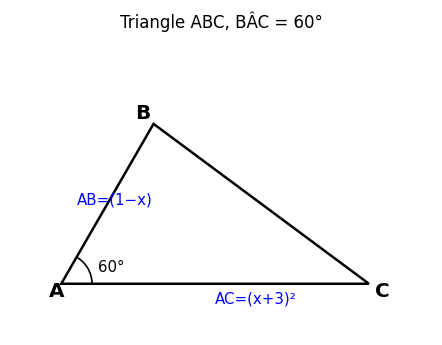
In a triangle ABC, BÂC = 60°, AB = (1 − x) cm, AC = (x + 3)² cm, where −3 < x < 1.
Answer
(a) A = ½·AB·AC·sin60° = ½(1−x)(x+3)²·(√3/2) = (√3/4)(1−x)(x+3)². (1−x)(x+3)² = (1−x)(x²+6x+9) = 9−3x−5x²−x³ ✓ (b)(i) dA/dx = (√3/4)(−3−10x−3x²) (ii) At x=−1/3: −3+10/3−3/9 = −3+10/3−1/3 = 0 ✓ (c)(i) d²A/dx² = (√3/4)(−10−6x); at x=−1/3: (√3/4)(−8) < 0 → maximum (ii) A_max = (√3/4)(9+1−5/9+1/27) = (√3/4)(280/27) = 70√3/27 ≈ 4.49 cm² (iii) BC ≈ 6.08 cm
A sector OAB has radius r cm and the angle AOB = θ radians. A chord AB is drawn.
Answer
(a) Segment = Sector − Triangle = ½r²θ − ½r²sinθ = ½r²(θ−sinθ) ✓ (b) Perimeter = 2r + rθ = r(θ+2) = 30 → r = 30/(θ+2). A = ½r²θ = ½·(900/(θ+2)²)·θ = 450θ/(θ+2)² ✓ (c) dA/dθ = 450[(θ+2)²−2θ(θ+2)]/(θ+2)⁴ = 450(2−θ)/(θ+2)³ = 0 → θ = 2 (d) A_max = 450(2)/(4)² = 900/16 = 56.25 cm²
Let a = (2, −1, 3) and b = (1, 4, −2).
Answer
(a) a·b = 2 − 4 − 6 = −8 (b) |a| = √14, |b| = √21; cosθ = −8/√294 ≈ −0.467; θ ≈ 117.8° (c) a×b = (−10, 7, 9) (d) −10x + 7y + 9z = 0
Line L₁ passes through A(1,2,0) with direction d₁ = (1,1,2). Line L₂ passes through B(3,0,1) with direction d₂ = (2,−1,1).
Answer
(a) L₁: (1+t, 2+t, 2t); L₂: (3+2s, −s, 1+s) (b) Setting equal leads to contradiction → Lines are skew (c) d₁×d₂ = (3,3,−3); AB = (2,−2,1). Distance = |AB·(d₁×d₂)|/|d₁×d₂| = |6−6−3|/√27 = 3/(3√3) = 1/√3 = √3/3
A Ferris wheel has diameter 40 m. The centre is 25 m above ground. It completes one full rotation every 50 seconds.
Answer
(a) h(t) = 25 − 20cos(πt/25) (b) 25−20cos(πt/25)=40 → cos(πt/25)=−3/4 → t ≈ 19.3, 30.7, 69.3, 80.7 seconds (c) h'(t) = (4π/5)sin(πt/25); h'(10) = (4π/5)sin(2π/5) ≈ 2.37 m/s
Prove the identity: cos 2θ = 1 − 2sin²θ. Hence prove:
Answer
Identity: cos2θ = cos²θ−sin²θ = 1−2sin²θ ✓ (a) cos(π/6)=1−2sin²(π/12); √3/2=1−2sin²(π/12); sin²(π/12) = (2−√3)/4 ✓ (b) 4sin²x − 2cos2x = 4sin²x − 2(1−2sin²x) = 8sin²x − 2 = 3 → sin²x = 5/8 → sinx = ±√(5/8). x = arcsin(√(5/8)), π−arcsin(√(5/8)), π+arcsin(√(5/8)), 2π−arcsin(√(5/8)) ≈ 0.675, 2.467, 3.817, 5.609 rad
Two buildings stand on flat ground. Building A is 50 m tall. From the top of A, the angle of depression to the base of B is 30°, and the angle of elevation to the top of B is 20°.
Answer
(a) tan30° = 50/d → d = 50/tan30° = 50√3 ≈ 86.6 m (b) Height of B = 50 + d·tan20° = 50 + 86.6·tan20° ≈ 50 + 31.5 = 81.5 m (c) Angle = arctan(81.5/86.6) ≈ 43.3° (d) Horizontal = 86.6, Vertical diff = 31.5; Distance = √(86.6²+31.5²) ≈ 92.1 m