Functions - Practice Set 1
Unit: Functions
Practice questions covering quadratic functions, completing the square, discriminants, Vieta's formulas, graph transformations, inverse functions, asymptotes, polynomial division, logistic models, optimization, and more.
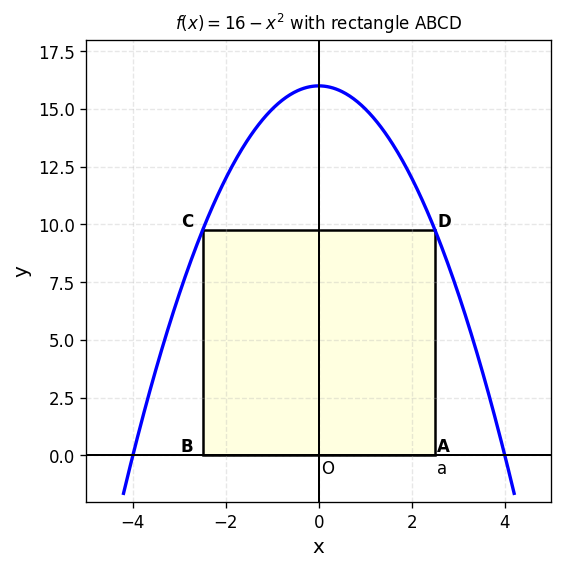
Let f(x) = 16 − x², for x ∈ ℝ.
The following diagram shows part of the graph of f. Rectangle ABCD is drawn with A and B on the x-axis and C and D on the graph of f. Let OA = a.
Let g(x) = (x − 4)² + k, for x ∈ ℝ, where k is a constant.
Answer
(a) x = ±4 (b) Width = 2a, height = f(a) = 16−a². Area = 2a(16−a²) = 32a−2a³ ✓ (c) dA/da = 32−6a² = 0 ⇒ a = √(16/3) = 4/√3 ≈ 2.31 (d) 16−x² = (x−4)²+k ⇒ 16−x² = x²−8x+16+k ⇒ 2x²−8x+k = 0 ✓ (e) Discriminant = 0: 64−8k = 0 ⇒ k = 8
The population of a town t years after 1 January 2014 can be modelled by the function P(t) = 15000e^(kt), where k < 0 and t ≥ 0. It is known that between 1 January 2014 and 1 January 2022 the population decreased by 11%. Use this model to estimate the population of this town on 1 January 2041.
Answer
P (January 2041) ≈ 10 100. P(8) = 15000e^(8k) = 15000 × 0.89 ⇒ k = ln(0.89)/8 ≈ −0.01459; t=27: P(27) ≈ 15000e^(−0.01459×27) ≈ 10,080 ≈ 10,100
Complete the square for f(x) = x² − 6x + 11. State the vertex form and identify the vertex. Find the discriminant and comment on the nature of roots.
Answer
f(x) = (x − 3)² + 2; Vertex: (3, 2). Discriminant: b²−4ac = 36 − 44 = −8 < 0 → No real roots; parabola lies entirely above x-axis.
The graph of y = f(x) passes through (0, 2) and has a maximum at (3, 5).
Answer
(a) Shift right 2, up 1: maximum at (5, 6) (b) Reflection in the y-axis (x replaced by −x) (c) Many valid answers; e.g. translate right 2, up 1: a=1, b=1, c=2, d=1
The quadratic function f(x) = x² + bx + c has roots α and β.
Answer
(a) α + β = −b, αβ = c (b) b = −7, c = 10. f(x) = x² − 7x + 10 (c) α² + β² = (α+β)² − 2αβ = 49 − 20 = 29
The function f(x) = eˣ − 3 is defined for x ∈ ℝ.
Answer
(a) f⁻¹(x) = ln(x+3) (b) Domain: x > −3, Range: ℝ (c) eˣ − 3 = ln(x+3). Solving numerically: x ≈ 1.512
Sketch the function f(x) = (x² − x − 6)/(x − 1) showing all asymptotes, intercepts and any holes. State the equations of all asymptotes.
Answer
Factorise numerator: (x−3)(x+2). No common factor with (x−1). Vertical asymptote: x = 1. Polynomial division: (x²−x−6)/(x−1) = x + 0 − 6/(x−1) → oblique: y = x. x-intercepts: x = 3 and x = −2. y-intercept: f(0) = 6.
The discriminant of kx² − 2kx + 1 = 0 is investigated.
Answer
(a) Δ = 4k² − 4k = 4k(k−1) (b) Two distinct real roots when Δ > 0: k < 0 or k > 1 (c) Equal roots when Δ = 0: k = 1; x² − 2x + 1 = 0 → x = 1
The function f(x) = 3x³ − ax² + bx − 5 has a root at x = 1 and leaves a remainder of 7 when divided by (x + 1).
Answer
(a) f(1)=0 → −a + b = 2; f(−1)=7 → −a − b = 15 (b) a = −8.5, b = −6.5 (c) f(x) = (x−1)(3x² + 11.5x + 5)
A function is transformed as follows: g(x) = −2f(3x − 6) + 1.
Answer
(a) Write g(x) = −2f(3(x−2))+1: 1. Horizontal compression by factor 1/3; 2. Horizontal shift right by 2; 3. Vertical stretch by factor 2; 4. Reflection in x-axis and shift up 1 (b) Point: (8/3, −9) (c) g(x) = −2(3x−6)² + 1 = −18x²+72x−71; Vertex: (2, 1)
f(x) = x³ − 3x² + 4. Use calculus (differentiation) to:
Answer
(a) f'(x)=3x²−6x=3x(x−2)=0 → x=0 (local max), x=2 (local min) (b) Increasing: x < 0 and x > 2; Decreasing: 0 < x < 2 (c) Cubic shape, local max (0,4), local min (2,0), y-intercept (0,4)
The polynomial P(x) = x⁴ − 2x³ + ax² + bx + 10 has roots α, β, γ, δ.
Answer
(a) α+β+γ+δ = 2; Σαβ = a; Σαβγ = −b; αβγδ = 10 (b) a = 7, b = −10
The equation 2x³ + px² − 5x + q = 0 has roots α, β, γ such that α + β = 0.
Answer
(a) α+β+γ = −p/2. Since α+β=0 ⇒ γ = −p/2 ✓ (b) γ=1 ⇒ p=−2; αβ+(α+β)γ = −5/2 ⇒ αβ=−5/2; αβγ = −q/2 ⇒ q=5 (c) α = √(10)/2, β = −√(10)/2, γ=1
The functions f and g are defined as: f(x) = e^(2x) − 4 and g(x) = ln(x + 2).
Answer
(a) f(g(x)) = e^(2ln(x+2)) − 4 = (x+2)² − 4 = x² + 4x (b) g(f(x)) = ln(e^(2x)−2) (c) f(g(x)) = x²+4x ≠ x ⇒ not inverses ✓ (d) f⁻¹(x) = ln(x+4)/2, domain x > −4
The function f(x) = x³ − 6x² + 11x − 6 is given.
Answer
(a) f(1) = 0 ✓; f(x) = (x−1)(x²−5x+6) = (x−1)(x−2)(x−3) (b) All three roots are real: x = 1, 2, 3 (c) f'(x) = lim_{h→0} [f(x+h)−f(x)]/h = 3x² − 12x + 11
An exponential model: N(t) = N₀/(1 + ke^(−rt)) is used to model population growth (logistic model).
Answer
(a) N → N₀ (carrying capacity) (b) N(0) = N₀/(1+k) ⇒ k = N₀/N(0) − 1 (c) N(0) = 1000/10 = 100. S-shaped (logistic) curve starting at 100, asymptote N=1000.
The function h(x) = |2x − 4| + |x + 1|.
Answer
(a) Critical points: x = 2 and x = −1 (b) For x < −1: h = 3 − 3x; For −1 ≤ x < 2: h = 5 − x; For x ≥ 2: h = 3x − 3 (c) Minimum at x = 2: h(2) = 3
f(x) = (x³ − 8)/(x² − 4). Find the partial fraction decomposition and sketch the graph.
Answer
(a) Numerator: (x−2)(x²+2x+4); Denominator: (x−2)(x+2) (b) f(x) = (x²+2x+4)/(x+2) for x ≠ 2; hole at (2, 3) (c) (x²+2x+4)/(x+2) = x + 0 + 4/(x+2); Oblique asymptote: y = x; Vertical asymptote: x = −2
A ball is thrown upward from a cliff. Its height above the ground is: h(t) = −5t² + 20t + 60, where t is in seconds and h is in metres.
Answer
(a) h(2) = 80 metres (maximum height) (b) t = 6 seconds (c) Downward parabola, h-intercept (0,60), vertex (2,80), t-intercept (6,0)
Let f(x) = 16 − x², for x ∈ ℝ.
Answer
(a) x = ±4 (b) Area = 2a(16−a²) = 32a−2a³ ✓ (c) a = 4/√3 ≈ 2.31 (d) 2x²−8x+k = 0 ✓ (e) k = 8
The function f is defined by f(x) = ln(xeˣ + 1) − x², for 0 ≤ x ≤ 2. The graph of f has a local maximum at point A and crosses the x-axis again at point B.
Answer
(a) A = (0.710, 0.390) (by GDC) (b) x ≈ 1.35 (c) Total area ≈ 0.703 (d) f(1) ≈ 0.313; f'(1) ≈ −0.817; Normal gradient ≈ 1.224; Equation: y − 0.313 = 1.224(x − 1)
The quadratic function f(x) = x² + bx + c has roots α and β.
Answer
(a) α+β = −b, αβ = c (b) b = −7, c = 10; f(x) = x² − 7x + 10 (c) α²+β² = 29 (d) shift right 3, shift up 2; roots: x = 5, x = 8
The population of a town t years after 1 January 2014 is modelled by P(t) = 15000 e^(kt), where k < 0. Between 1 January 2014 and 1 January 2022, the population decreased by 11%.
Answer
(a) k = ln(0.89)/8 ≈ −0.01459 (b) P(27) ≈ 10 080 (c) t > 27.9 → Year 2042 (d) Model assumes continuous exponential decline; in reality migration, birth rate changes etc.
The function f(x) = 3x³ − ax² + bx − 5 has a root at x = 1 and leaves remainder 7 when divided by (x + 1).
Answer
(a) −a + b = 2; −a − b = 15 (b) a = −8.5, b = −6.5 (c) f(x) = (x−1)(3x² + 11.5x + 5)
A transformation g(x) = −2f(3x − 6) + 1 is applied to f(x).
Answer
(a) 1. Horizontal compression by factor 1/3; 2. Horizontal translation right 2; 3. Vertical stretch by factor 2; 4. Reflection in x-axis, then translation up 1 (b) (8/3, −9) (c) g(x) = −18x²+72x−71; Vertex: (2, 1)
Let f(x) = eˣ − 3.
Answer
(a) f⁻¹(x) = ln(x + 3) (b) Domain: x > −3; Range: ℝ (c) f: y-intercept (0,−2), x-intercept (ln3,0), asymptote y=−3; f⁻¹: reflection in y=x (d) x ≈ 1.512; Intersection lies on y = x (symmetric functions)
Consider the logistic model N(t) = N₀/(1 + ke^(−rt)) for population growth.
Answer
(a) N → N₀ (carrying capacity) (b) N(0) = N₀/(1+k) ⇒ k = N₀/N(0) − 1 (c) t = ln9/0.3 ≈ 7.32
A ball is thrown from a cliff. Its height h(t) = −5t² + 20t + 60 metres, where t ≥ 0.
Answer
(a) Vertex at t = 2: h(2) = 80 m (b) t = 6 s (c) h-intercept (0,60), vertex (2,80), t-intercept (6,0) (d) [h(3)−h(0)]/3 = [75−60]/3 = 5 m/s