Calculus - Practice Set 1
Calculus
Practice questions covering differentiation rules, tangent lines, integration (definite and indefinite), area between curves, volumes of revolution, optimization, related rates, differential equations, Maclaurin series, and L'Hopital's rule.
Differentiate with respect to x:
Answer
(a) f'(x) = 12x² − 6x + 2 (b) g(x) = x^(1/2) + x^(−1). g'(x) = ½x^(−1/2) − x^(−2) = 1/(2√x) − 1/x² (c) Product rule: h'(x) = 2e^(2x)sin(x) + e^(2x)cos(x) = e^(2x)(2sinx + cosx)
Find the equation of the tangent to y = x² − 3x + 2 at the point where x = 3.
Answer
y(3) = 9−9+2 = 2. Point: (3, 2). y' = 2x−3. Slope at x=3: m = 3. Tangent: y−2 = 3(x−3) → y = 3x − 7
Integrate:
Answer
(a) x³ + x² − x + C (b) eᶲ + sinx + C
A particle moves with velocity v(t) = 3t² − 6t + 2.
Answer
(a) a(t) = 6t−6. a(2) = 12−6 = 6 m/s² (b) s = ∫₀³ (3t²−6t+2)dt = [t³−3t²+2t]₀³ = 27−27+6 = 6 m
Evaluate ∫₁³ (2x + 1)dx using the fundamental theorem of calculus.
Answer
∫(2x+1)dx = x²+x+C. [x²+x]₁³ = (9+3)−(1+1) = 12−2 = 10
Find ∫ x·sin(x) dx using integration by parts. Hence evaluate ∫₀π x·sin(x) dx
Answer
Let u=x, dv=sinx dx → du=dx, v=−cosx. ∫xsinx dx = −xcosx + ∫cosx dx = −xcosx + sinx + C. [−xcosx + sinx]₀^π = (−π·(−1)+0)−(0+0) = π
Find the area enclosed between y = x² and y = 4 − x².
Answer
Intersection: x² = 4−x² → 2x²=4 → x=±√2. Area = ∫ from −√2 to √2 of [(4−x²)−x²]dx = ∫ (4−2x²)dx = [4x − 2x³/3] evaluated = 2[4√2 − 2(2√2)/3] = 2[4√2 − 4√2/3] = 2·8√2/3 = 16√2/3
A box (no lid) has square base with side x and height h. Volume = 500 cm³.
Answer
(a) Volume: x²h=500 → h=500/x². S = x² + 4xh = x² + 4x(500/x²) = x² + 2000/x (b) S'= 2x − 2000/x² = 0 → x³ = 1000 → x = 10 cm; S''= 2+4000/x³ > 0 at x=10 → minimum ✓
Use integration by substitution to find:
Answer
(a) Let u=x²+1, du=2x dx. ∫u⁴du = u⁵/5+C = (x²+1)⁵/5+C (b) Let u=3x, du=3dx. ∫cos(u)du/3 = sin(3x)/3+C (c) Let u=x²+1, du=2x dx. (1/2)∫du/u = (1/2)ln|x²+1|+C
A particle has displacement s(t) = t³ − 9t² + 24t − 10.
Answer
(a) v(t) = 3t²−18t+24 = 3(t−2)(t−4) = 0 → At rest: t=2 and t=4. (b) s(0)=−10, s(2)=10, s(4)=6, s(5)=10. Distance = |10−(−10)| + |6−10| + |10−6| = 20+4+4 = 28 m
f(x) = (3x + 1)/(x² − x − 2). Find:
Answer
(a) x²−x−2=(x−2)(x+1). Vertical: x=2, x=−1. Horizontal: y=0. Domain: ℝ\{2,−1} (b) f'(x) = [3(x²−x−2)−(3x+1)(2x−1)]/(x²−x−2)². Numerator: 3x²−3x−6−(6x²−3x+2x−1) = −3x²−2x−5. f'(x) = (−3x²−2x−5)/(x²−x−2)² (c) Discriminant of −3x²−2x−5: 4−60 = −56 < 0. No real roots. No stationary points.
Diagram: Region R is bounded by y=ex, y=1, and x=2. Shade region R.
Answer
(a) Boundaries: eᶲ=1 at x=0. Area = ∫₀² (eᶲ−1)dx = [eᶲ−x]₀² = (e²−2)−1 = e²−3 (b) V = π∫₀² (eᶲ)²dx − π∫₀²1²dx = π∫₀²e^(2x)dx − 2π = π[e^(2x)/2]₀² − 2π = π(e⁴/2−1/2)−2π = π(e⁴−5)/2 (c) V = 2π∫₀² x·eᶲ dx = 2π[xeᶲ−eᶲ]₀² = 2π[(2e²−e²)−(0−1)] = 2π(e²+1)
Find y' using implicit differentiation for:
Answer
(a) 2x + 2y·y' = 0 → y' = −x/y (b) 2xy + x²y' + 3y²y' = 0 → y'(x²+3y²) = −2xy → y' = −2xy/(x²+3y²) (c) e^(xy)·(y + xy') = 1 + y'. At (0,1): e⁰(1 + 0·y') = 1+y' → 1 = 1+y' → y' = 0
Related rates: A spherical balloon is inflated so its volume increases at 100 cm³/s.
Answer
(a) V = 4πr³/3 → dV/dt = 4πr²·dr/dt → 100 = 4π(25)·dr/dt → dr/dt = 100/(100π) = 1/π cm/s (b) S = 4πr² → dS/dt = 8πr·dr/dt = 8π(5)(1/π) = 40 cm²/s (c) r = h/2. V = (1/3)πr²h = (1/3)π(h/2)²h = πh³/12 → dV/dt = πh²/4·dh/dt → 20 = π(36)/4·dh/dt → dh/dt = 80/(36π) = 20/(9π) cm/s
Solve the differential equation dy/dx = 2xy, given y(0) = 3.
Verify your solution. Sketch the solution curve.
Answer
Separate variables: dy/y = 2x dx. Integrate: ln|y| = x² + C → y = Ae^(x²). Initial condition: y(0)=3 → A=3. y = 3e^(x²). Verify: dy/dx = 3·2x·e^(x²) = 6x·e^(x²) = 2x·(3e^(x²)) = 2xy ✓. Sketch: bell-curve shape, y(0)=3, increasing for x>0, symmetric.
Answer
(a) sin(x) = x − x³/6 + x⁵/120 − ... (b) sin(x)/x = 1 − x²/6 + x⁴/120 − ... → limit as x→0 is 1. (c) sin(x²) = x² − x⁶/6 + x¹⁰/120 − ... (d) ∫₀^(0.5) (x²−x⁶/6+x¹⁰/120) dx = [x³/3−x⁷/42+x¹¹/1320]₀^(0.5) = (0.125/3−0.0078125/42+...) = 0.04167−0.000186+... ≈ 0.0415
Use L'Hopital's rule to evaluate:
Answer
(a) Form 0/0. Apply L'H: (eᶲ−1)/2x. Still 0/0. Apply again: eᶲ/2 → 1/2. (b) x/eᶲ. As x→∞, form ∞/∞. Apply L'H: 1/eᶲ → 0. (c) x·lnx = lnx/(1/x). Form −∞/∞. Apply L'H: (1/x)/(−1/x²) = −x → 0.
The rate of cooling of coffee follows Newton's Law: dT/dt = −k(T−20), where T°C is temperature, t is time in minutes, and k is a positive constant.
Answer
(a) Separate: dT/(T−20) = −k dt → ln|T−20| = −kt + C → T = 20 + Ae(−kt) (b) T(0)=90: A=70. T(5)=60: 60=20+70e(−5k) → e(−5k)=40/70=4/7 → k = −ln(4/7)/5 = ln(7/4)/5 ≈ 0.112 (c) T(15) = 20+70e(−3·ln(7/4)) = 20+70(4/7)³ = 20+70(64/343) = 20+13.1 = 33.1°C
Diagram: The region bounded by y = sin(x) and y = cos(x) for 0 ≤ x ≤ π/2.
Answer
(a) tan(x)=1 → x = π/4. (b) For 0≤x≤π/4: cosx > sinx. For π/4≤x≤π/2: sinx > cosx. (c) Area = ∫₀^(π/4) (cosx−sinx)dx + ∫_(π/4)^(π/2) (sinx−cosx)dx = [sinx+cosx]₀^(π/4) + [−cosx−sinx]_(π/4)^(π/2) = (√2−1) + (−1 − (−√2)) = (√2−1) + (√2−1) = 2(√2−1)
A company's profit rate is dP/dt = 50e(0.1t) − 20t, where P is in $000s and t in years.
Answer
(a) P(t) = ∫(50e(0.1t)−20t)dt = 500e(0.1t) − 10t² + C. P(0)=0: 500+C=0 → C=−500. P(t) = 500e(0.1t) − 10t² − 500 (b) dP/dt = 0: 50e(0.1t) = 20t → solve numerically (GDC): t ≈ 14.3 years (c) P(14.3) = 500e(1.43) − 10(204.5) − 500 ≈ 500(4.177)−2045−500 ≈ $543k
Use integration by parts twice to evaluate ∫ ex·cos(x) dx. Hence evaluate ∫₀π ex·cos(x) dx.
Answer
Let I = ∫eᶲcosx dx. IBP: u=cosx, dv=eᶲdx → I = eᶲcosx + ∫eᶲsinx dx. IBP again: ∫eᶲsinx dx = eᶲsinx − ∫eᶲcosx dx = eᶲsinx − I. So: I = eᶲcosx + eᶲsinx − I → 2I = eᶲ(cosx+sinx). ∫eᶲcosx dx = eᶲ(cosx+sinx)/2 + C. Definite: [eᶲ(cosx+sinx)/2]₀π = eπ(cosπ+sinπ)/2 − e⁰(cos0+sin0)/2 = e^π(−1+0)/2 − (1+0)/2 = −e^π/2 − 1/2 = −(e^π+1)/2
Diagram: Volume of revolution. The region bounded by y=√x, y=0, and x=4 is rotated 360° about the x-axis.
Answer
(a) V = π∫₀⁴ (√x)² dx = π∫₀⁴ x dx (b) V = π[x²/2]₀⁴ = π·8 = 8π (c) About y-axis (disc method): x=y², y from 0 to 2. V = π∫₀² (4)²dy − π∫₀² y⁴ dy = 16π(2)−π(32/5)=32π−32π/5=128π/5
The second order differential equation: y'' − 3y' + 2y = 0.
Answer
(a) r² − 3r + 2 = 0 → (r−1)(r−2)=0 → r=1, r=2 (b) y = Ae^x + Be^(2x) (c) y(0)=3: A+B=3; y'=Ae^x+2Be^(2x), y'(0)=5: A+2B=5 → Solving: B=2, A=1 → y = eᶲ + 2e^(2x) (d) As x→∞, e^(2x) dominates → y→∞. Solution grows without bound.
f(x) = x²·ln(x) for x > 0.
Answer
(a) f'(x) = 2x·lnx + x²·(1/x) = 2xlnx + x = x(2lnx+1); f''(x) = (2lnx+1) + x·(2/x) = 2lnx+3 (b) f'(x)=0: x=0 (excluded) or 2lnx+1=0 → lnx=−1/2 → x=e^(−1/2)=1/√e; f''(1/√e) = 2(−1/2)+3 = 2 > 0 → local minimum. f(1/√e) = (1/e)·(−1/2) = −1/(2e) (c) ∫₁^e x²lnx dx. IBP: u=lnx, dv=x²dx → v=x³/3 = [x³lnx/3]₁^e − ∫₁^e x²/3 dx = (e³/3−0) − [x³/9]₁^e = e³/3 − e³/9 + 1/9 = 2e³/9 + 1/9
A ladder of length 5m leans against a vertical wall. The bottom slides away from the wall at 0.3 m/s.
Answer
(a) x² + y² = 25 (b) 2x·dx/dt + 2y·dy/dt = 0. x=3: y=4. 2(3)(0.3) + 2(4)dy/dt = 0 → dy/dt = −0.225 m/s (c) Let θ = angle with ground: sinθ = y/5 → cosθ·dθ/dt = (1/5)dy/dt; cosθ = 3/5 at x=3. (3/5)dθ/dt = (1/5)(−0.225) → dθ/dt = −0.225/3 = −0.075 rad/s (d) Area = xy/2. dA/dt = (1/2)(y·dx/dt + x·dy/dt) = (1/2)(4·0.3 + 3·(−0.225)) = (1/2)(1.2−0.675) = 0.2625 m²/s (increasing)
Consider the functions f and g on the domain 0 < x < 2π:
f(x) = 4 cos 2x and g(x) = 2 − 8 cos x
The following diagram shows the graphs of y = f(x) and y = g(x).
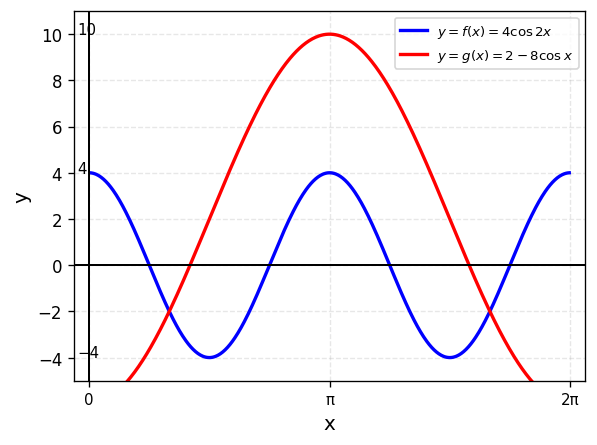
At points P and Q on the diagram, the gradients of the two graphs are equal.
Answer
(a) Intersections at x = π/3, 2π/3, 4π/3, 5π/3 (b) Area = 2π + 6√3 (using ∫[π/3 to 2π/3](g−f)dx and symmetry) (c) Equal gradients: cos x = −1/2 → x = 2π/3; g(2π/3) = 2+4 = 6
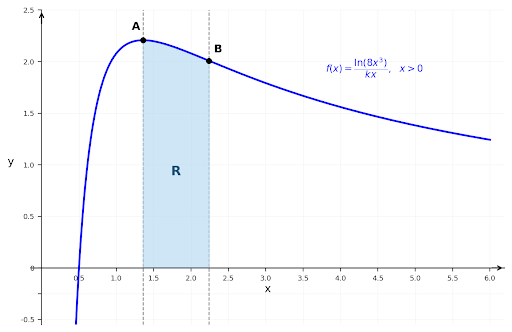
Let f(x) = ln(8x³)/(kx), where x > 0, k ∈ ℝ⁺
The graph of f has exactly one maximum point A. The second derivative is f''(x) = [2ln(8x³) − 9]/(kx³). The graph has exactly one point of inflection B. The region R is enclosed by the graph of f, the x-axis, and the vertical lines through A and B.
Answer
(a) f'(x) = [kx·(3/x) − k·ln(8x³)]/(kx)² = [3 − ln(8x³)]/(kx²) ✓ (b) f'(x) = 0: ln(8x³) = 3 → 8x³ = e³ → x = e/2 (c) f''(x) = 0: 2ln(8x³) = 9 → ln(8x³) = 9/2 → 8x³ = e^(9/2) → x³ = e^(9/2)/8 → x = e^(3/2)/2 ✓ (d) ∫[e/2 to e^(3/2)/2] ln(8x³)/(kx) dx = 5 → Evaluate integral and solve for k → k ≈ 1.47 (by GDC or substitution)
A particle has displacement s(t) = t³ − 9t² + 24t − 10.
Answer
(a) v(t) = 3t²−18t+24 = 3(t−2)(t−4) = 0 → t = 2 and t = 4 (b) s(0)=−10, s(2)=10, s(4)=6, s(5)=10; Distance = |10−(−10)| + |6−10| + |10−6| = 20+4+4 = 28 m (c) a(t) = 6t−18; a(3) = 0 m/s² (momentarily constant velocity at t=3)
Use integration by parts twice to find ∫eᶲ cos x dx. Hence evaluate ∫₀^π eᶲ cos x dx.
Answer
(a) I = eᶲcos x + ∫eᶲ sin x dx (b) ∫eᶲsin x dx = eᶲsin x − ∫eᶲcos x dx = eᶲsin x − I (c) I = eᶲcos x + eᶲsin x − I → 2I = eᶲ(cos x + sin x) → ∫eᶲcos x dx = eᶲ(cos x + sin x)/2 + C (d) [eᶲ(cosx+sinx)/2]₀^π = e^π(−1+0)/2 − e⁰(1+0)/2 = −e^π/2 − 1/2 = −(e^π+1)/2
Solve the differential equation dy/dx = 2xy, given y(0) = 3.
Answer
(a) dy/y = 2x dx → ln|y| = x² + C → y = Ae^(x²) (b) y(0) = 3 → A = 3; ∴ y = 3e^(x²) (c) dy/dx = 3·2x·e^(x²) = 6xe^(x²) = 2x·(3e^(x²)) = 2xy ✓ (d) y-intercept at (0,3); curve grows rapidly for x ≠ 0; y → ∞ as x → ±∞
A box (no lid) has a square base with side x cm and height h cm. Volume = 500 cm³.
Answer
(a) h = 500/x²; S = x² + 4x(500/x²) = x² + 2000/x (b) S' = 2x − 2000/x² = 0 → x³ = 1000 → x = 10 cm (c) S'' = 2 + 4000/x³ > 0 at x=10 → minimum ✓ (d) S_min = 100 + 200 = 300 cm²
Find the area enclosed between y = x² and y = 4 − x².
Answer
(a) x² = 4−x² → 2x²=4 → x = ±√2; Points: (−√2, 2) and (√2, 2) (b) Area = ∫ from −√2 to √2 of [(4−x²)−x²] dx = ∫ (4−2x²) dx (c) = [4x − 2x³/3] evaluated = 2(4√2 − 4√2/3) = 16√2/3
Newton's Law of Cooling: dT/dt = −k(T − 20), where T°C is temperature, t is time in minutes.
Answer
(a) T = 20 + 70e^(−kt) (b) 60 = 20+70e^(−5k) → e^(−5k) = 4/7 → k = ln(7/4)/5 ≈ 0.112 (c) T(15) = 20+70e^(−3ln(7/4)) = 20+70(4/7)³ = 20+70(64/343) ≈ 33.1°C (d) 25 = 20+70e^(−kt) → e^(−kt) = 1/14 → t = ln14/k ≈ 23.6 min
Use the Maclaurin series to find lim as x→0 of [sin x − x + x³/6] / x⁵.
Answer
(a) sin x = x − x³/6 + x⁵/120 − x⁷/5040 + … (b) sin x − x + x³/6 = x⁵/120 − …; divide by x⁵: → 1/120 (c) sin(x²) ≈ x² − x⁶/6 + x¹⁰/120; ∫₀^0.5 ≈ [x³/3 − x⁷/42 + x¹¹/1320]₀^0.5 ≈ 0.04167 − 0.000186 + 0.0000003 ≈ 0.0415
A ladder of length 5 m leans against a vertical wall. The bottom slides away at 0.3 m/s.
Answer
(a) x² + y² = 25 (b) 2x(dx/dt) + 2y(dy/dt) = 0; x=3,y=4: 2(3)(0.3)+2(4)(dy/dt)=0 → dy/dt = −0.225 m/s (c) cosθ·(dθ/dt) = (1/5)(dy/dt); cosθ=3/5: dθ/dt = −0.075 rad/s (d) Area = xy/2; dA/dt = (1/2)(y·dx/dt + x·dy/dt) = (1/2)(4×0.3+3×(−0.225)) = 0.2625 m²/s; Area is increasing at 0.2625 m²/s