Genetic Inheritance
Genetic Inheritance

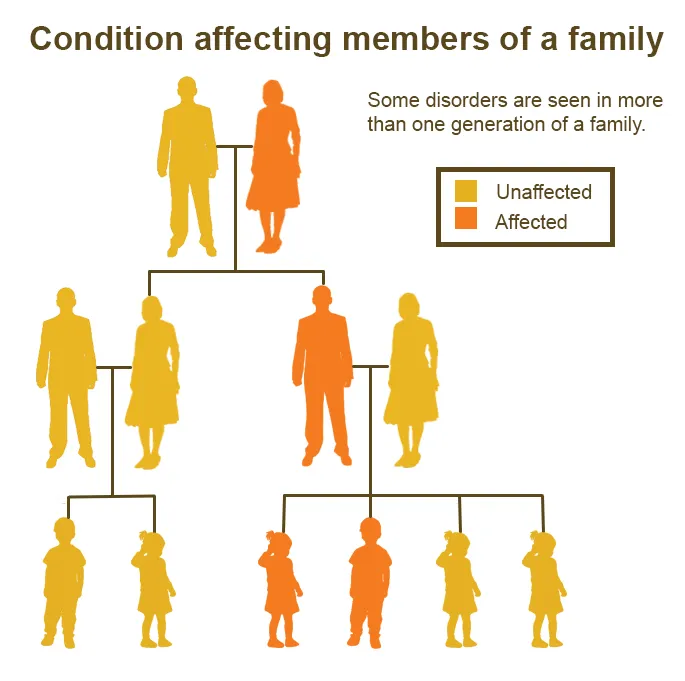
Genetic inheritance refers to the transmission of biological information encoded in DNA from parents to offspring. Genes influence a wide range of psychological characteristics, including intelligence, personality traits, susceptibility to mental disorders, and some cognitive abilities. However, it is critical to understand that genes do not determine behaviour directly; rather, they set tendencies and predispositions that interact with environmental factors.
How Genetic Inheritance Works
How Genetic Inheritance Works
Humans have 23 pairs of chromosomes in every cell nucleus, each containing thousands of genes. Each person inherits one set of chromosomes from each biological parent. Most psychological traits are polygenic — influenced by many genes working in combination — rather than being controlled by a single gene. This means that genetic inheritance of psychological characteristics is probabilistic rather than deterministic.
Twin studies have been the primary method for estimating heritability — the proportion of variance in a trait that can be attributed to genetic factors in a given population. Identical (monozygotic) twins share 100 percent of their DNA, while fraternal (dizygotic) twins share approximately 50 percent. If a trait has a genetic component, identical twins should show higher concordance rates (both having the trait) than fraternal twins. Studies of intelligence, for instance, consistently find concordance rates of approximately 75 to 85 percent for identical twins compared to 40 to 55 percent for fraternal twins.
Genetic Influence on Mental Health
Genetic Influence on Mental Health
Research identifies genetic contributions to many mental health conditions. Twin studies estimate the heritability of schizophrenia at around 80 percent and the heritability of major depressive disorder at approximately 35 to 40 percent. The heritability of autism spectrum disorder has been estimated at over 80 percent in some twin studies. However, it is important not to interpret heritability estimates as fixed or absolute — heritability describes a statistical relationship within a specific population and environment, not an immutable biological fate.
Specific gene variants associated with psychological disorders have been identified through genome-wide association studies (GWAS). The MAOA-L gene variant (sometimes called the warrior gene) has been associated with increased aggression and antisocial behaviour, particularly in males who have also experienced childhood maltreatment — demonstrating gene-environment interaction rather than pure genetic determination. Similarly, the 5-HTT gene variant studied by Caspi et al. (2003) predisposes individuals to depression only in combination with environmental stress.
Evaluation
Evaluation
Genetic inheritance research has produced important insights into the biological basis of development and psychopathology. However, heritability estimates from twin studies are population-specific and environmental influences are often underestimated because identical twins frequently share not only genes but also environments. The media tendency to identify ‘genes for’ specific traits vastly oversimplifies the polygenic, probabilistic nature of genetic influence on behaviour. Importantly, genetic predispositions are not fixed destinies — epigenetic processes (chemical modifications to DNA that affect gene expression without changing the sequence) allow environmental experiences to influence which genes are activated or silenced.